

SYLLABUS
GS-2: Government policies and interventions for development in various sectors and issues arising out of their design and implementation.
Context: Recently, the Union Ministry of Health and Family Welfare has notified key amendments to the New Drugs and Clinical Trials (NDCT) Rules, 2019, to reduce regulatory burden and promote Ease of Doing Business in the pharmaceutical and clinical research sector.
More on the News
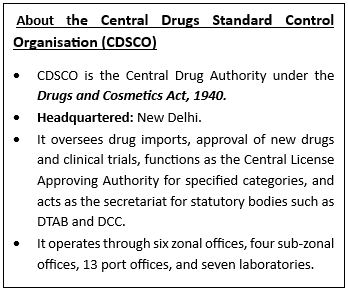
• Under the existing regulatory framework, pharmaceutical companies were required to obtain a test license from the Central Drugs Standard Control Organisation (CDSCO) for manufacturing small quantities of drugs for examination, research, or analysis.
• CDSCO processes nearly 30,000–35,000 test licence applications annually, leading to procedural delays.
Key Amendments Introduced
• Prior-Intimation in Place of Test Licence: The requirement of a test licence for non-commercial manufacture has been replaced with a prior-intimation mechanism.
- Pharmaceutical companies may now commence drug development upon submitting an online intimation to CDSCO.
- Exception: High-risk drugs such as cytotoxic, narcotic, and psychotropic substances will continue to require test licences.
• Reduction in Regulatory Timelines: The reform is expected to result in a minimum saving of 90 days in the drug development life cycle.
- For categories where test licences remains mandatory, the statutory processing timeline has been reduced from 90 days to 45 days.
• Relaxation for Low-Risk BA/BE Studies: To expedite clinical research, the requirement of obtaining prior permission for certain low-risk Bioavailability/Bioequivalence (BA/BE) studies has been dispensed with.
- Such studies can now be initiated based on a simple online intimation to CDSCO, benefiting especially the generic pharmaceutical industry.
Digital Enablement and Implementation
• Dedicated online modules will be made available on the
- National Single Window System and
- the SUGAM portal.
• The SUGAM portal enables transparent submission and tracking of regulatory intimations and maintains a comprehensive database of permissions and licences issued by regulatory authorities.
Significance
• Substantial reduction in regulatory burden.
• Faster initiation of clinical research and drug development.
• Optimised utilisation of CDSCO manpower.
• Alignment of India’s drug regulatory framework with global best practices.
• Strengthening India’s position as a global hub for pharmaceutical R&D, while ensuring public health and safety.