
SYLLABUS
GS-2: Issues Relating to Development and Management of Social Sector/Services relating to Health, Education, Human Resources; Government Policies and Interventions for Development in various sectors and Issues arising out of their Design and Implementation.
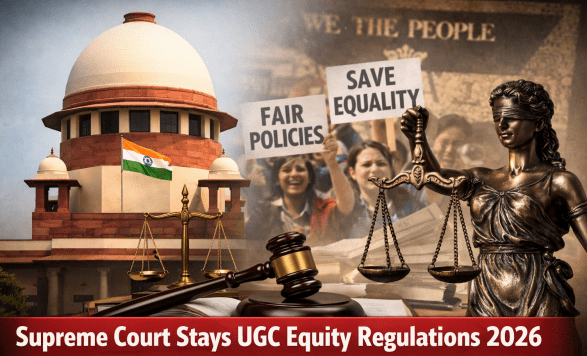
Context: The Supreme Court has stayed the University Grants Commission’s (UGC) new equity rules, stating that the rules were prima facie vague and have the potential to divide society.
More on the News
• The UGC (Promotion of Equity in Higher Education Institutions) Regulations, 2026, were introduced by the government to supersede the UGC Regulations, 2012 with the stated objective of fostering equity, inclusion and a discrimination-free academic environment across higher education institutions in line with the National Education Policy, 2020.
• Using the powers under Article 142, the Supreme Court, while putting the 2026 Regulations in abeyance for the time being, directed that the UGC Regulations, 2012, would continue to be in force.
• The petitioners have primarily challenged Section 3(1)(c) of the 2026 Regulations, saying it refers to discrimination only on the basis of caste or tribe against the members of SC, ST and OBC communities while excluding those from the general category.
Need for New Regulations
• According to the UGC, complaints related to caste-based discrimination have increased by over 118% in five years, from 173 cases in 2019–20 to 378 in 2023–24.
• During 2019–20 to 2023–24, a total of 1,160 complaints were received from 704 universities and 1,553 colleges nationwide.
Key Provisions of the Regulations
• Definition of Caste-Based Discrimination: Defined discrimination specifically against members of the Scheduled Castes (SCs), Scheduled Tribes (STs), and Other Backwards Classes (OBCs) communities.
• Broaden the Definition of Discrimination: Discrimination has defined on broader grounds such as unfair, biased or differential treatment whether explicit or implicit, as caste, religion, race, gender, place of birth, or disability, including acts that impair equality in education or violate human dignity.
• Mandatory Equity Committees: Every higher education institution (HEI) must constitute an Equity Committee, which must include members from OBC, SC, ST, persons with disabilities (PwDs), and women.
- Unlike the 2012 regulations, the new rules have expanded the definition of caste-based discrimination to include OBCs.
• Equal Opportunity Centres (EOCs): Each Higher education institution (HEI) must also set up an Equal Opportunity Centre, which will be operated by the equity committee.
- Its duties include promoting equality among students, teaching staff, and non-teaching staff.
- spreading awareness about government welfare schemes
- helping students from disadvantaged backgrounds access academic and financial support.
• Mandatory Compliance: For the first time, the Regulations prescribe stringent penalties for non-compliance, including debarment from UGC funding, prohibition on launching new programmes, and derecognition as a UGC-approved institution.
• Grievance Redressal Mechanism:
- Institutions are mandated to create time-bound mechanisms to inquire into complaints of caste-based discrimination.
- The Centre will also run an online portal to report discrimination complaints and operate an ‘Equity Helpline’ for assistance.
Issues and Challenges in the Regulations
• Unequal Protection and Exclusion: By restricting “caste-based discrimination” to SC, ST, and OBC categories, the Regulations risk excluding students from the unreserved category who may also experience discrimination, raising concerns of unequal protection.
• Removal of the False Complaint Penalty: The absence of explicit safeguards or penalties against malicious or false complaints has raised concerns about potential misuse and the creation of a climate of fear within academic institutions.
• Constitutional Violation: Petitioners contend that the Regulations institutionalise a hierarchy of protection and lack adequate procedural safeguards, thereby potentially violating the Right to Equality under Articles 14 and 15 of the Constitution.
• Inadequate Capacity: Experts point out that while the rules are strict on paper, many HEIs lack the administrative and financial capacity to run 24/7 helplines, independent inquiries, and continuous compliance monitoring.