
SYLLABUS
GS-2: Government policies and interventions for development in various sectors and issues arising out of their design and implementation.
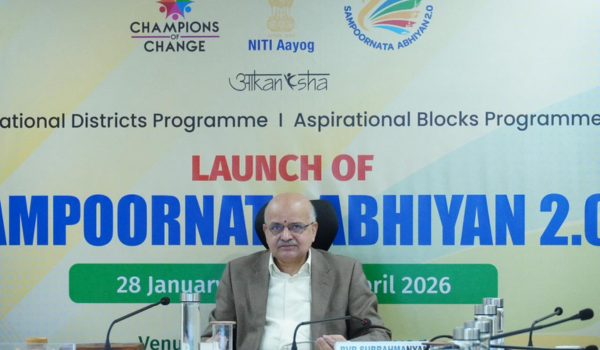
Context: Recently, NITI Aayog launched Sampoornata Abhiyan 2.0, a mission-mode initiative aimed at achieving full saturation of key development indicators in Aspirational Districts and Aspirational Blocks across the country.
More on the News
• The campaign will run for three months, from 28 January to 14 April 2026.
• The Abhiyan seeks to achieve total coverage (saturation) of:
- 5 Key Performance Indicators (KPIs) in 112 Aspirational Districts and
- 6 Key Performance Indicators (KPIs) in 513 Aspirational Blocks.
• It represents a focused effort to accelerate progress in India’s most underdeveloped regions through outcome-based governance.
Key Objectives of Sampoornata Abhiyan 2.0
• To build upon the successful outcomes of the Sampoornata Abhiyan 2024, which was a 3-month mission-mode campaign aimed at achieving 100% saturation of selected development indicators.
• To ensure last-mile delivery of critical services through focused and time-bound interventions.
• To strengthen outcome-based monitoring and accountability under the Aspirational Districts and Blocks Programme.
Key Performance Indicators (KPI)s for Aspirational Blocks (6):
1. Percentage of children from 6 months to 6 years taking Supplementary Nutrition under the ICDS programme regularly.
2. Measurement efficiency of children enrolled at Anganwadi Centres during the reporting month.
3. Percentage of operational Anganwadi Centres with functional toilets.
4. Percentage of operational Anganwadi Centres with drinking water facilities.
5. Percentage of schools having an adequate number of girls’ toilet facilities.
6. Percentage of bovine animals vaccinated against Foot and Mouth Disease (FMD).
Key Performance Indicators (KPIs) for Aspirational Districts (5):
1. Proportion of live babies weighted at birth.
2. Tuberculosis (TB) case notification rate (Public and Private Institutions) against estimated cases.
3. Percentage of Anganwadis centres/Urban PHCs that conducted at least one Village Health Sanitation & Nutrition day / Urban Health Sanitation & Nutrition Day (UHSND) in the last one month.
4. Percentage of schools with functional girls’ toilets.
5. Percentage of animals vaccinated.
Implementation Strategy
• Districts and Blocks will prepare three-month action plans to achieve saturation of the identified indicator.
• Monthly tracking and review of progress will be undertaken.
• Awareness generation and behaviour change campaigns will be implemented at the grassroots level.
• Concurrent field monitoring visits will be conducted by district-level officers to ensure real-time assessment and corrective action.
Significance of the Sampoornata Abhiyan 2.0
• The Abhiyan marks a strategic shift toward result-oriented and saturation-based governance in India’s most challenging regions.
• Saturation as a development benchmark ensures that no eligible beneficiary is left out, reflecting the Antyodaya philosophy of reaching the last person.
• The initiative promotes convergence and collaboration among the Central Ministries, State Governments, and local administrations, improving inter-departmental synergy.
• Through institutionalised monitoring, capacity building, and systems strengthening, the campaign lays a blueprint for sustainable and scalable grassroots service delivery.
About the Aspirational Districts and Blocks Programme
| Aspect | Aspirational Districts Programme (ADP) | Aspirational Blocks Programme (ABP) |
| Launch | January 2018 | January 2023 |
| Coverage | 112 Districts | 513 Blocks across 329 Districts |
| Objective | Rapid transformation of underdeveloped districts | Saturation of essential government services at the block level |
| Focus Areas / Themes | Health & Nutrition; Education; Agriculture & Water Resources; Financial Inclusion & Skill Development; Infrastructure | Health & Nutrition; Education; Agriculture and Allied Services; Basic Infrastructure; Social Development |
| Monitoring Mechanism | Outcome-based indicators | Outcome-based indicators |
| Number of Indicators | 49 Indicators | 40 Indicators |