
SYLLABUS
GS-1: Geographical features and their location-changes in critical geographical features (including water-bodies and ice-caps) and in flora and fauna, and the effects of such changes.
GS-3: Conservation, environmental pollution and degradation, environmental impact assessment.
Context: Recently, the Nagpur Bench of the Bombay High Court has initiated a suo motu Public Interest Litigation after taking note of an emerging ecological and heritage crisis at the Lonar Crater Lake in Maharashtra’s Buldhana district.
More in the News
• The court’s intervention follows reports of a sharp rise in the lake’s water level, which now threatens ancient temples and endangers the crater’s unique saline ecosystem.
• The action was taken to preserve the lake’s natural state and protect the area’s ancient temples.
• A petition was filed stating that the water level in Lonar Lake has risen by nearly 20 feet, leading to the partial and complete submergence of several centuries-old heritage structures along the crater rim.
- Nine of the fifteen ancient temples in the area, estimated to be over 1,200 years old, are now either partially or fully submerged, with the Kamalja Devi, Daitya Sudhan, Motha Maruti, and Gaumuk temples facing immediate threat.
• The petition warns that influx of freshwater is rapidly diluting the lake’s salinity and lowering its pH levels. This change is allowing freshwater species to enter the lake, posing a serious threat to the rare bacteria, fungi, and protozoa that can survive only in highly saline conditions.
• Causes of Water Level Rise in Lonar Lake:
- Heavy rainfall in 2025
- Untreated sewage water entering the lake
- Excessive tree plantation drives undertaken by the Forest Department and the Archaeological Survey of India (ASI) have reportedly increased soil moisture retention, reduced evaporation, and forced excess water into the crater.
- Water percolation, possible seepage from the Kini Percolation Tank, located about two kilometres from the crater.
About Lake Lonar
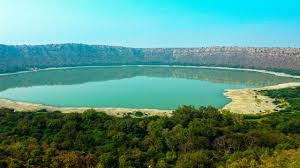
• Lonar Lake is a lake in Buldhana district of Maharashtra state, created due to a meteorite impact during the Pleistocene Epoch.
• It is the only known saline crater lake in the world, formed by the impact of a meteorite about 50,000 years ago.
• Its water is nearly seven times saltier than seawater, with the lake spanning about 1.2 kilometres in diameter, reaching a depth of 150 meters, and being encircled by a rim of hills rising upto 75 degrees.
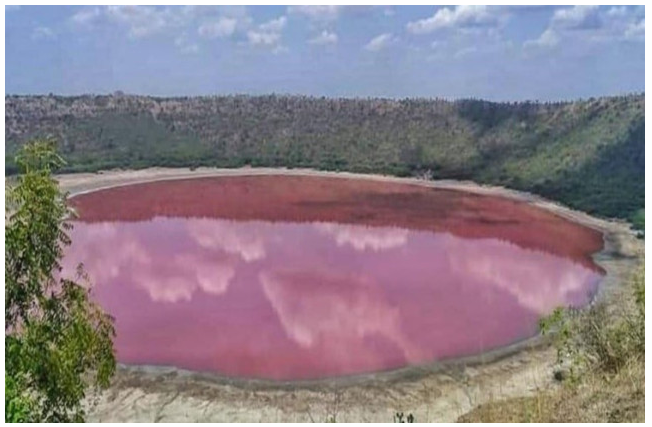
• The pink colouration of Lonar Lake water is attributed to the proliferation of salt-loving haloarchaea microbes, which produce reddish carotenoid pigments under high salinity and alkaline conditions.
• It is the only known impact crater in the basaltic rock of the Deccan Plateau, which was formed by massive volcanic eruptions 65 million years ago.
• The impact of the meteorite created a shock wave that melted and shattered the basalt, producing a glassy material called maskelynite.
• It has been declared a Wildlife Sanctuary, recognised as a Ramsar site in November 2020 for its ecological and cultural value, and protected by the Geological Survey of India as a national geo-heritage monument.
• The lake also hosts a rich diversity of flora and fauna, some of which are endemic to the region.