
SYLLABUS
GS-3: Awareness in the fields of IT, Space, Computers, robotics, Nano-technology, bio-technology and issues relating to intellectual property rights.
Context: Recently, the Chief of Defence Staff General Anil Chauhan released the Military Quantum Mission Policy Framework, a comprehensive document that includes the policy and the roadmap to implement Quantum Technologies in the Armed Forces.
More on the News
- The Chief of Defence Staff General released the Framework in the presence of the Chiefs of the Army, Navy and Air Force and senior defence leadership, on 22 January 2026 in New Delhi.
- The document lays down a policy vision and implementation roadmap for inducting quantum technologies into the Indian Armed Forces.
Key features of the Military Quantum Mission Policy Framework
- Aim: To integrate the following four pillars of Quantum into the Tri-Services to empower them to prepare for the future battlefield and to achieve technological dominance in the rapidly evolving world:-
- Quantum Communication: Enable ultra-secure military communication networks.
- Quantum Computing: Enhance high-speed computation for defence applications.
- Quantum Sensing and Metrology: Improve navigation accuracy and detection capabilities in denied environments.
- Quantum Materials and Devices: Support next-generation defence platforms and hardware.
- Defines the way Ahead:
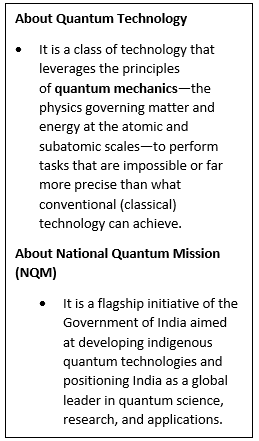
- To achieve synergy in the amalgamation of quantum technologies, alignment with the National Quantum Mission of which the Defence Forces are an integral part.
- To formulate an indicative roadmap and policy for implementation of the niche field in Defence forces.
- Civil-military fusion: The document highlights the milestones & goals to be achieved by utilising civil-military fusion though dedicated governing bodies consisting of members across multiple Government sectors.
- Future Battle Readiness: The framework highlights the critical need for jointness and integration in assimilating Quantum technology to achieve technological supremacy in future battlefield.
Institutional and Strategic Significance
- Unified Adoption in Tri-service: The policy stresses the need for jointness and integration across the Army, Navy and Air Force leading to increased interoperability.
- Civil-military fusion: collaboration with research institutions and industry will bring in-house expertise and skill pool to accelerate technology development.
- Strategic Edge in emerging Quantum Warfare: The framework reflects global military trends where quantum and post-quantum cryptography are becoming strategic priorities.
- Aligning with National Quantum Mission: It forms the basis of incorporating cutting-edge quantum technology into the Armed Forces through synergised efforts of all three services.
Existing Quantum-related research Initiative by the Defence players:
- DRDO is a key stakeholder under the National Quantum Mission. It established the Quantum Technology Research Centre in Delhi in May 2025.
- The Army operates a Quantum Laboratory at Military College of Telecommunication Engineering (MCTE), Mhow.
- The Air Force runs an AI Centre of Excellence under the UDAAN framework.
- The Navy collaborates with the Raman Research Institute for secure quantum-based maritime communication.