
SYLLABUS
GS-2: Government policies and interventions for development in various sectors and issues arising out of their design and implementation.
GS-3: Conservation, environmental pollution and degradation, environmental impact assessment.
Context: Recently, NITI Aayog released three reports on decarbonisation roadmaps for cement, aluminium and MSME sectors.
More on the News
- These three reports have been prepared in consultation with line ministries/ departments, industry stakeholders, research institutions and knowledge partners.
- India’s economic expansion will be driven by rising industrial activity and major infrastructure development, with increasing manufacturing’s share of GDP from 17% to 25% as a central national objective.
Key Highlights of the Reports
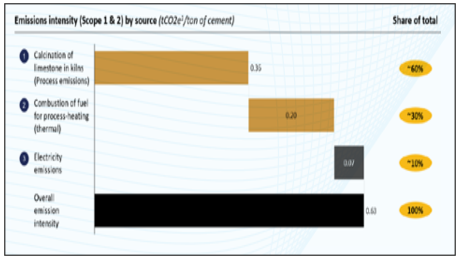
- Roadmap for Cement Sector Decarbonisation:
- The report highlights that cement production is likely to increase sevenfold to ~2100 million tonnes in 2070, from the level of 391 million tonnes in 2023.
- Under the decarbonisation strategy, the cement sector must reduce its carbon intensity from 0.63 tCO₂e (metric tons of carbon dioxide equivalent) per tonne of cement to approximately 0.09-0.13 tCO₂e per tonne by 2070.
- The report recommends prioritising refuse-derived fuels, clinker substitution, expanded Carbon Capture, Utilisation and Storage (CCUS), and effective carbon credit trading to achieve deep decarbonisation in the sector.
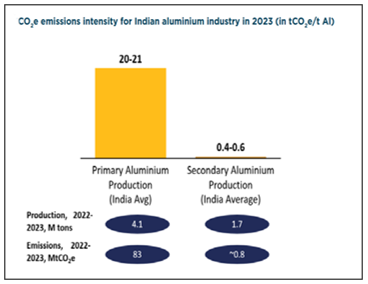
- Roadmap for Aluminium Sector Decarbonisation:
- Aluminium production is projected to increase from 4 million tonnes in 2023 to 37 million tonnes by 2070.
- The decarbonisation roadmap outlines three phases: short-term Renewable Energy-Round the Clock (RE-RTC) power and stronger grid connectivity, medium-term adoption of nuclear power, and long-term integration of CCUS.
- Roadmap for Msme Sector Decarbonisation:
- India’s MSMEs underpin the industrial economy, contributing ~30% of GDP, employing over 250 million people, and generating about 46% of exports.
- The Roadmap for Green Transition of MSMEs focuses on three key levers: deployment of energy-efficient equipment, adoption of alternative fuels, and integration of green electricity.
About Decarbonisation
- Decarbonisation is the removal or reduction of all human-made carbon emissions into the atmosphere.
- It is achieved through cross-cutting measures to reduce or eliminate carbon emissions from an organisation’s or an individual’s activities.
- It differs from climate neutrality because it seeks to reduce absolute carbon emissions and intensity.
Source
PIB
Plana Earth