

SYLLABUS
GS 3: Conservation, environmental pollution and degradation
Context: Recently, the Environment Ministry amended the Greenhouse Gases (GHGs) Emission Intensity Target Rules, 2025, to bring four additional sectors under its ambit, in support of India’s net-zero ambitions.
More on the News
- Greenhouse Gases Emission Intensity Target Rules, 2025 were notified on October 8, 2025 requiring industrial units across the aluminium, cement, pulp and paper and chlor-alkali sectors to reduce their greenhouse gas emissions per unit of output (emission intensity) from the 2023-24 baseline levels.
- The four newly added sectors—Petroleum Refineries, Petrochemicals, Textiles, and Secondary Aluminium—join the previously notified sectors (Aluminium, Cement, Chlor-Alkali, and Pulp & Paper) to bring the total to eight highly carbon-intensive industries now under a mandatory emission reduction regime.
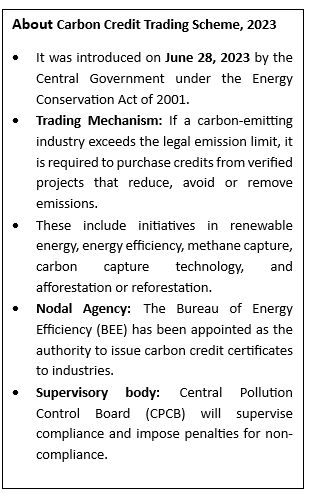
- These Rules have been notified under the compliance mechanism of the Carbon Credit Trading Scheme, 2023.
About Greenhouse Gases Emission Intensity Target (Amendment) Rules, 2025
- Expansion of Coverage: Petroleum refineries, petrochemicals, textiles, and secondary aluminium are now required to cut emissions by a stipulated amount following their inclusion in the country’s GHG emissions intensity reduction regime.
- List of Industrial units affected: As per the new norms, it has been made mandatory for as many as 208 industrial units spread across the country to reduce GHG emissions per unit of product (emission intensity), beginning 2025-26. 208 industrial units included across 4 sectors are as follows:
- 173 textile units across sectors such as spinning, processing, fibre and composite.
- 21 petro refineries.
- 11 petrochemical units.
- 3 secondary aluminium units.
- Bharat Petroleum, Hindustan Petroleum, Indian Oil and Numaligarh Refineries and large private-sector groups such as Reliance Industries have been covered under petroleum refinery and petrochemicals sectors.
- Emission reduction targets & timeline: These sectors are expected to meet specific reduction targets in the range of 3-7 % by 2026-27 compared to a 2023-24 baseline.
- Penalty for Non-compliance: If an industrial unit fails to comply with the targets or fails to submit carbon credit certificates equivalent to the shortfall for compliance, CPCB will impose ‘environmental compensation’ (penalty) for the shortfall.
- The penalty will be twice the average price at which carbon credit certificate is traded during the trading cycle of that compliance year.
- It will have to be paid within 90 days of the date of the imposition order.
Significance of the Rules
- Support India’s Climate Commitments: The rule aligns with India’s commitment under the 2015 Paris Agreement to decrease the emissions intensity of its GDP by 45 % by 2030, relative to 2005 levels.
- Binding framework: These rules set India’s first legally binding emission reduction targets for carbon-intensive industries.
- Promotion of Carbon Markets: Industries exceeding the prescribed emission limits required to purchase carbon credits from verified projects that reduce, avoid, or remove emissions.
- This incentivizes investment in clean technologies and the voluntary carbon market.