
SYLLABUS
GS-2: Bilateral, regional and global groupings and agreements involving India and/or affecting India’s interests; Important International institutions, agencies and fora – their structure, mandate
Context: Recently, the European Union and the Mercosur bloc of South American countries have formally signed a long-sought free trade agreement in Asuncion, Paraguay, concluding more than 25 years of negotiations to deepen economic ties and expand trade relations.
Key Features of the Agreement
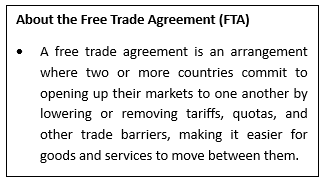
- Tariff Reduction and Market Access: The deal aims to eliminate over 90% of tariffs on goods traded between the EU and Mercosur.
- Some tariff cuts will be phased in over 10 to 15 years.
- Mercosur will expand EU access to South American markets for industrial exports, including cars, machinery, machinery parts, chemicals, pharmaceuticals, and wine.
- In return, the EU will provide access for South American agricultural products, including beef, soybeans, poultry, and sugar, often under quota limits intended to protect sensitive sectors.
- Economic Scale: Combined,the EU–Mercosur market represents over 700 million consumers and accounts for a significant share of global GDP.
- Bilateral trade between the two regions was about €111 billion ($128.8 billion) in 2024.
- The agreement is expected to increase exports, support jobs, and promote investment on both sides of the Atlantic, with EU exports potentially increasing substantially over time.
- Geopolitical Importance: EU leaders, including European Commission President Ursula von der Leyen, described the deal as a major geopolitical victory that reinforces cooperation amid rising global protectionism and trade tensions.
- It sends a message that South America intends to diversify partnerships beyond traditional powers, responding to global shifts including U.S. tariff pressures and China’s growing influence in the region.
- The agreement now requires approval by the European Parliament and ratification by the Mercosur legislatures of Argentina, Brazil, Paraguay, and Uruguay.
About the MERCOSUR
- MERCOSUR, the Southern Common Market, is a Latin American trading bloc established in 1991 to promote the free movement of goods, services, capital, and people.
- It became a customs union in January 1995 and is now pursuing the third stage of integration: a Common Market.
- Membership:
- Founding Members: Argentina, Brazil, Paraguay, and Uruguay (signatories of the Treaty of Asunción).
- Later Additions: Venezuela (joined in 2012; suspended since 2016) and Bolivia (incorporation agreed by all five members in July 2015).
- Associated States: Chile, Colombia, Ecuador, Guyana, Panama, Peru, and Surinam.
- Economic and Demographic Profile:
- MERCOSUR has over 290 million people and a GDP exceeding USD 2 trillion, making it the fourth largest integrated market after the EU, NAFTA, and ASEAN.
- Structure and Governance:
- Headquarters: Montevideo, Uruguay.
- Presidency: Rotates every six months, marked by summit meetings
About the European Union
- The EU is an international organization comprising 27 European countries, governing common economic, social, and security policies.
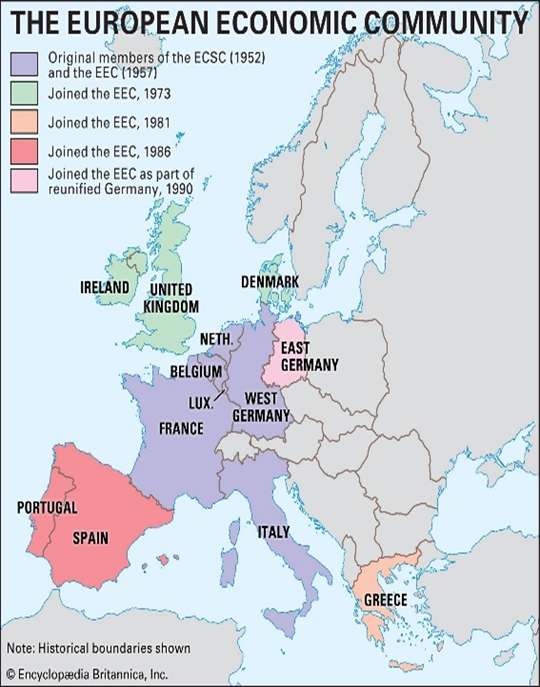
- The European Union traces its origins to 1951, when six countries signed the Treaty of Paris to create the European Coal and Steel Community, allowing free movement of coal, steel, workers, and capital.
- The EU was formally created by the Maastricht Treaty, which entered into force on November 1, 1993. The treaty aimed to:
- Establish a single currency (Euro).
- Create a common foreign and security policy.
- Introduce EU citizenship.
- Promote cooperation on immigration, asylum, and judicial affairs.
- Current EU Members: Austria, Belgium, Bulgaria, Croatia, Cyprus, Czech Republic, Denmark, Estonia, Finland, France, Germany, Greece, Hungary, Ireland, Italy, Latvia, Lithuania, Luxembourg, Malta, Netherlands, Poland, Portugal, Romania, Slovakia, Slovenia, Spain, and Sweden.
- The United Kingdom, a founding member, officially left the EU in 2020.
- The EU received the Nobel Peace Prize in 2012 for promoting peace and democracy.
- 20 countries have adopted the euro since its launch in 1999, with Bulgaria becoming the 21st eurozone member on January 1, 2026.
Source:
Reutes
Mercosur
Britannica