

SYLLABUS
GS-2: Government Policies and Interventions for Development in various sectors and Issues arising out of their Design and Implementation.
Context: The Supreme Court bench comprising Justices Sanjay Karol and N Kotiswar Singh has urged the Union Law Secretary to consider initiating steps to curb the misuse of the Protection of Children from Sexual Offences (POCSO) Act, 2012.
More on the News:
- The observation came at a time when a Public Interest Litigation (PIL), where the age of consent has emerged as a point of contention, is already pending before the court.
- Supreme Court judgment signalled that the criminalisation of adolescent sexuality requires a structural, rather than just a judicial, solution.
Argument in favour of Romeo-Juliet clause
• Protect genuine adolescent relationships: Any sexual activity involving a person under 18 is automatically criminalized in present legal framework, regardless of whether it is consensual or non-exploitative.
- Under the POCSO Act, a child is defined as any person below the age of 18, and the Act does not recognise a minor’s consent to sexual acts.
• Judicial anxiety: A study by the Enfold Proactive Health Trust and UNICEF found that nearly 25% of POCSO cases in the states of Maharashtra, Assam and West Bengal between 2016 and 2020 were “romantic” in nature — in which the victim and the accused were in a consensual relationship.
• Grim Societal Chasm: The court pointed out that the POCSO Act, which is a “solemn articulation of justice”, is frequently used by families to oppose relationships between young people.
- This leads to the incarceration of young boys under the POCSO Act for relationships devoid of coercion.
• Demand for change: The push to amend the law is not new but it has gained a boost through a pending PIL in the Supreme Court related to protections and safeguards for women in the prosecution of sexual offences.
• Sexual Autonomy: Adolescents between the ages of 16 and 18 possess the “evolving capacity” to make decisions regarding their sexual autonomy.
- The “Mature Minor” doctrine from common law treats all those under 18 as incapable of consent ignored scientific reality and the biological onset of puberty.
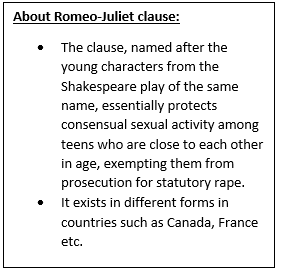
• “Close-in-age” exception: To ensure that if both parties are adolescents and the act is consensual, it would not be treated as an offence.
• Health implications: The mandatory reporting provision in POCSO forces doctors to report underage pregnancies or sexual activity to the police. This fear of prosecution deters adolescents from seeking essential sexual and reproductive health services.
Union government Standing on Issue:
• No to Statutory Dilution: The Union government has opposed any reduction in the age of consent or the introduction of legislative exceptions.
- In its submissions before the court in the matter, the government argued that the age of 18 is a “deliberate, well-considered” legislative choice aimed at creating a non-negotiable “protective shield” for children.
• Irrelevancy of Consent: The government contended that minors lack the legal and developmental capacity to give meaningful consent. A strict liability framework where consent is irrelevant was necessary, it argued, because children are vulnerable to manipulation and coercion by adults in positions of trust.
• Prone to misuse: The government expressed fear that introducing exceptions or lowering the age of consent could open loopholes for child abuse and trafficking under the guise of consensual relationships.
• Old oil in New lamp effect: Since the Act was enacted to remedy the specific mischief of child abuse, diluting the age threshold, it argued, would reintroduce the very problem the law sought to solve.
Way forward
• Introduce a Carefully Drafted Close-in-Age Exception: Senior Advocate Indira Jaising, assisting the court as amicus curiae, has advocated for reading down the age of consent or introducing exceptions.
- Jaising argued that the current blanket criminalisation violated the fundamental rights of adolescents under Articles 14, 15, 19, and 21 of the Constitution.
- In 2023, the Law Commission of India advised against lowering the age of consent to 16.
• Need for Nuanced Approach: Bring Close-in-age defences and adopt a maturity-based, child-centric approach to protect affectionate or harmless interactions from prosecution.
• Responsible Judicial Discretion: The courts can use sentencing discretion and grant relief at the stage of bail, quashing, or sentencing in clearly consensual cases.