
SYLLABUS
GS-2: Bilateral, regional and global groupings and agreements involving India and/or affecting India’s interests; Important International institutions, agencies and fora – their structure, mandate.
Context: Recently, a landmark UN biodiversity treaty (High Seas Treaty) to safeguard biodiversity in the high seas came into effect.
More on the News
• The U.N. treaty, also known as the Biodiversity Beyond National Jurisdiction (High Seas Treaty), finalised in March 2023 after 15 years, enables the creation of marine protected areas in international waters.
• High sea treaty came into force on 17 January 2026, in accordance with article 68(1) which reads as follows: “This Agreement shall enter into force 120 days after the date of deposit of the sixtieth instrument of ratification, approval, acceptance or accession”.
• The legally binding UN treaty covers the ocean zones that lie beyond national waters (namely, the “high seas”) and the international seabed area.
• These regions make up over two-thirds of the ocean’s surface, representing over 90 per cent of Earth’s habitat by volume.
• The treaty aims to conserve and regulate biodiversity in previously unprotected and unregulated ocean regions.
• The agreement will make it possible to:
- establish marine protected areas (MPAs) in the high seas
- regulate the exploitation of marine genetic resources
- assess the environmental impact of current and future human activities
- support developing countries through capacity-building and marine technology transfer programmes
• As per the Treaty:
- Countries are required to conduct environmental assessments for activities affecting ocean ecology.
- The treaty will establish mechanisms for sharing benefits from the blue economy, including marine genetic resources used in industries like biotechnology.
• The Agreement has so far been ratified by 83 Parties, including the EU and 16 of its Member States, and signed by 145 countries.
• Areas beyond national jurisdiction contain marine resources and biodiversity and provide invaluable ecological, economic, social, cultural, scientific and food security benefits to humanity.
• The new Treaty addresses these challenges, in particular in view of future increasing demands for marine resources (for example: for food, medication, energy).
About the High Seas Treaty
• The High Seas Treaty or the Biodiversity Beyond National Jurisdiction (BBNJ) Agreement is the third implementing agreement under the UN Convention on the Law of the Sea (UNCLOS).
• It was adopted by the UN General Assembly in June 2023, and opened for signature in September 2023.
• Objectives:
- Protect marine biodiversity in the high seas through demarcating Marine Protected Areas (MPAs).
- Sustainable use of marine genetic resources (MGRs) and equitable sharing of benefits arising from them.
- Mandate Environmental Impact Assessments (EIAs) for major activities in the high seas.
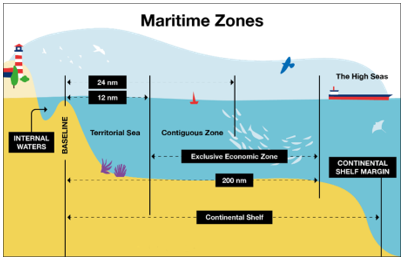
• The Treaty deals only with oceans that are outside the national jurisdiction of any country, i.e. beyond the EEZs.
• India signed the Treaty in September 2024 but has not ratified it yet.