

SYLLABUS
GS 1: Salient features of world’s physical geography.
GS 3: Conservation, environmental pollution and degradation.
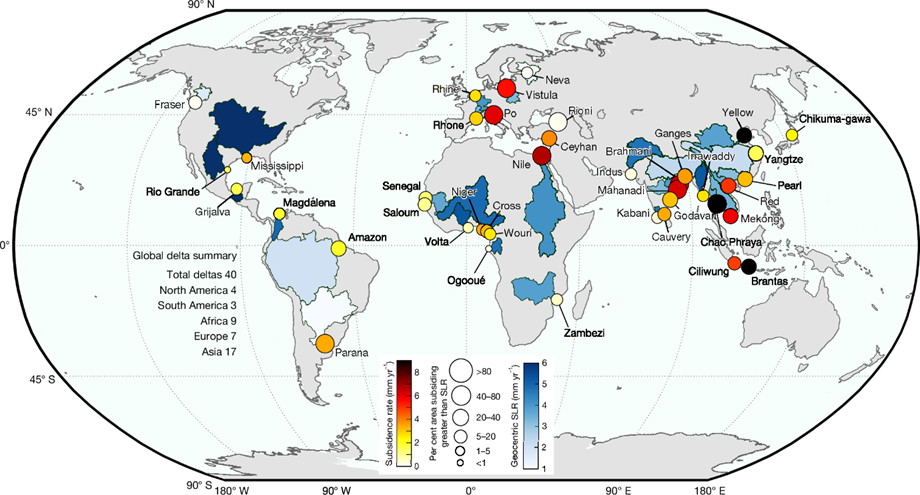
Context: A study published in journal Nature shows that major river deltas, including the Ganga-Brahmaputra, are sinking faster than sea levels are rising, increasing the risk of flooding.
More on the News:
- The research examined 40 major river deltas across 29 countries on five continents.
- River delta is a low-lying plain that is composed of stream-borne sediments deposited by a river at its mouth.
- The researchers selected deltas based on subsidence rates and horizontal land motion, focusing on areas with populations exceeding 3 million.
Key Findings of the Research:
Global Context:
- Rapid Delta Subsidence: Between 2014 and 2023, over half of the deltas experienced subsidence rates exceeding 3 mm per year.
- The study found that 35 % of the total delta area analysed is sinking, and in 38 of the 40 deltas, more than half of the area showed subsidence.
- Subsidence outpaces Sea-Level Rise: In 13 deltas including the Nile, Po, Vistula, Ceyhan, Brahmani, Mahanadi, Chao Phraya, Mekong, Red, Ciliwung, Brantas, Godavari, and Yellow River average subsidence rates surpassed the estimated global mean sea-level rise of roughly 4 mm per year.
- Habitable delta terrain Subsidence: Analysis of 40 river deltas shows that approximately 54–65% of the world’s habitable delta terrain is now sinking.
- Large Deltas Drive Most Land Subsidence: Seven major deltas such as Ganga-Brahmaputra, Nile, Mekong, Yangtze, Amazon, Irrawaddy and Mississippi, account for about 57 % of the total subsiding delta area worldwide.
India specific Findings:
- Land Subsidence in India’s Deltas: Nearly 50% of studied deltas including India’s Brahmani, Mahanadi, and Ganga-Brahmaputra experienced extensive subsidence, affecting over 90% of their total area.
- In 18 of the 40 deltas analysed, including India’s Brahmani, Mahanadi, Ganga-Brahmaputra and Godavari, local land subsidence is occurring faster than regional geocentric sea-level rise.
- Cauvery and Kabani deltas are also among those experiencing significant land subsidence.
- Fastest Sinking Deltas: The Brahmani and Mahanadi deltas stood out among the fastest sinking, with 77% and 69% of their areas subsiding, much of it at rates exceeding 5 mm per year.
- Delta Cities Sinking: Major cities located in delta regions are also sinking at rates equal to or higher than their surrounding landscapes.
- Kolkata, located in the Ganga-Brahmaputra delta, is among the cities experiencing significant subsidence, alongside Alexandria in the Nile delta, Bangkok in the Chao Phraya delta, Dhaka, and Shanghai.
- Indian deltas as “unprepared divers”: The researchers noted Indian deltas are experiencing high relative sea-level rise while lacking the institutional and financial capacity for adequate adaptation.
Key Factors Driving Delta Subsidence:
- Excessive Groundwater extraction: The study cites excessive groundwater extraction mainly for agriculture, industry, and domestic use in densely populated areas as a key driver of subsidence in the Ganga-Brahmaputra and Cauvery deltas.
- Reduced Sediment Supply: The Mahanadi and Kabani deltas are affected by a combination of groundwater depletion, reduced sediment supply due to upstream dams and levees, and population-driven land-use changes.
- Flood-Control measures: The study highlights that in the Nile, Po, and Mississippi deltas, dams and flood-control measures have led to significant sediment shortages and rapid subsidence.
- Land subsidence: The gradual sinking of the Earth’s surface has emerged as a major contributor to risk in river deltas.
Impact of River Delta Subsidence
- Vulnerability to flooding: Delta Subsidence amplifies vulnerability to coastal flooding, even without extreme sea-level rise.
- Infrastructure Damage: Subsidence damages farmland, disrupts freshwater supplies, promotes saltwater intrusion and accelerates wetland loss.
- Long-term displacement: Land loss and freshwater shortages can force migration, intensify competition for limited resources, and increase social tensions.
- Impact on Indigenous and Rural Communities: These communities, who often live in the lowest-lying areas below one metre above sea level face significant barriers to relocation due to their cultural, economic and subsistence ties to the land