
SYLLABUS
GS-3: Awareness in the fields of Space.
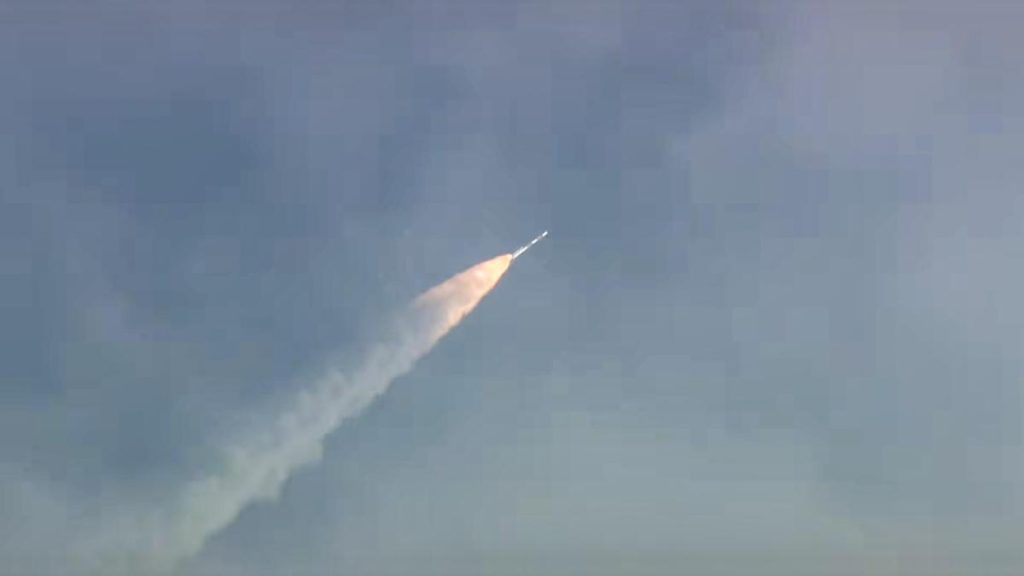
Context: India’s first space mission of 2026 faced a setback when ISRO’s PSLV-C62 launch experienced an anomaly during the third stage, raising concerns over recent PSLV reliability.
More on the News
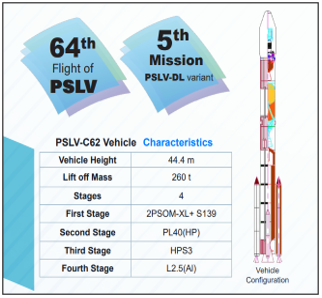
• The PSLV-C62 rocket lifted off from the Satish Dhawan Space Centre, Sriharikota, on 12 January 2026.
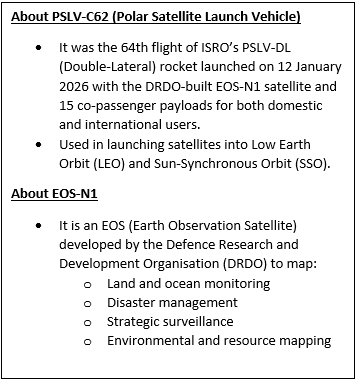
• The mission carried the EOS-N1 earth observation satellite along with 15 co-passenger satellites developed by startups and academic institutions from India and abroad.
• ISRO (Indian Space Research Organisation) confirmed that the mission encountered an anomaly close to the end of the PS3 stage following launch.
Key Details and Developments
• ISRO stated that the performance of the launch vehicle was normal up to the end of the third stage.
• The increased disturbance in vehicle roll rates was observed near the end of the PS3 stage, leading to a deviation in the intended flight path.
• The PS4 stage was planned to be restarted for de-boosting and re-entry along with the KID capsule into the South Pacific Ocean.
• A detailed data analysis has been initiated to determine the exact cause of the anomaly.
• EOS-N1 is an Earth observation satellite built for strategic purposes.
• The mission was a commercial launch executed through New Space India Limited.
• EOS-N1 and most co-passenger satellites were intended to be placed in a Sun Synchronous Orbit.
Broader Mission Significance
• This was the 105th launch from Sriharikota and the 64th flight of the PSLV launch vehicle.
• The mission used the PSLV-DL variant and marked ISRO’s first launch of 2026.
• The anomaly follows a similar PSLV failure in May 2025 during the EOS-09 mission, which also faced issues in the third stage.
• The back-to-back third-stage anomalies have highlighted the need for corrective measures in ISRO’s workhorse launch vehicle programme.
• Despite the setback, ISRO reaffirmed its commitment to transparency and timely corrective action to ensure mission reliability in future launches.