
SYLLABUS
GS-2: Bilateral, Regional and Global Groupings and Agreements involving India and/or affecting India’s interests.
Context: Six years after walking out of RCEP, India completes a circle, signing FTAs with every member of the world’s largest trading bloc—except China.
More on the News
• Once FTA between India and New Zealand, comes into effect, India would have such FTAs with all the countries in the RCEP except for China, giving India market access of RCEP without surrendering tariff control to China.
- A Free Trade Agreement (FTA) is a treaty between two or more countries to reduce or eliminate trade barriers among them in order to promote trade, investment and economic cooperation.
Reason for India to Back out of RCEP:
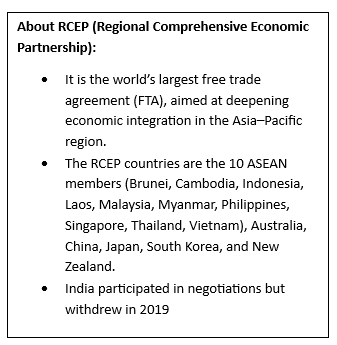
- Chinese Import Flooding: RCEP deal would have provided China virtually duty-free access to the Indian market without adequate Safeguards to domestic players.
- Excluding Market Access for Services: India’s strength lies in services (IT, professionals) while RCEP focused mainly on goods, offering limited commitments on movement of professionals.
- Absence of Auto-Trigger Mechanisms: India demanded Rules of Origin and an auto-trigger safeguard to reimpose tariffs if imports surged.
- Trade Deficit Concerns: India already had large trade deficits with many RCEP members, especially China.
India’s ‘RCEP minus China’ strategy to secure RCEP’s advantages:
• Smart risk management: By signing bilateral FTAs with 14 of the 15 RCEP members and keeping China limited to a narrow APTA framework, India secures market access without surrendering tariff control.
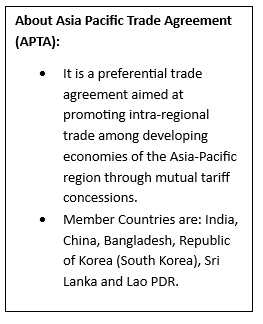
- ASEAN–India Free Trade Agreement (AIFTA) – Covers 10 ASEAN countries: Indonesia, Thailand, Malaysia, Singapore, Vietnam, Philippines, Myanmar, Cambodia, Laos, Brunei.
- India–Japan Comprehensive Economic Partnership Agreement (CEPA)
- India–South Korea CEPA
- India–Singapore Comprehensive Economic Cooperation Agreement (CECA)
- India–Australia Economic Cooperation and Trade Agreement (ECTA)
- India-New Zea¬l¬and Free Trade Agree¬ment (FTA) (announced the con¬clu¬sion of nego¬ti-ations on Decem¬ber 22, 2025)
• Access without systemic vulnerability: Bilateral deal with individual RCEP countries allowed India to exclude sensitive sectors and pace liberalization of economy.
• Limits China’s economic leverage: RCEP’s integrated structure acted as China-centric multilateral pact and would have enabled indirect entry of Chinese goods via other members.
Other important initiatives to deepen trade and supply-chain integration with RCEP members except China:
- Supply Chain Resilience Initiative (SCRI): a trilateral economic cooperation framework launched by India, Japan, and Australia to build resilient, diversified, and trusted supply chains in the Indo-Pacific.
- IPEF (Indo-Pacific Economic Framework): a U.S.-led economic initiative launched to strengthen economic cooperation, supply chains and rule-making in the Indo-Pacific without being a traditional Free Trade Agreement (FTA).
- I2U2 (India-Israel-UAE-USA) grouping: It complements RCEP access by Integrating India into global value chains and Strengthens India’s position as an alternative manufacturing hub.