
SYLLABUS
GS-3: Conservation, environmental pollution and degradation, environmental impact assessment.
Context: The Supreme Court (SC) took the matter on suo motu basis, after widespread protests by political parties, environmentalists and civil society members over the revised definition of the Aravalli hills.
More on the News
- The matter was listed as ‘Definition of Aravalli Hills and Mountain Ranges and Related Issues’ and is to be heard by a three-judge bench of the apex court, headed by the CJI Surya Kant and Justices J K Maheshwari and Augustine George Masih on December 29, Monday.
Background related to Aravalli’s Defination:
• May 2024: The SC asked for a uniform definition of the Aravallis across four states — Gujarat, Rajasthan, Haryana and Delhi — in the context of mining.
• November 2025: The new definition recommended by the Environment Ministry–appointed committee was accepted by SC.
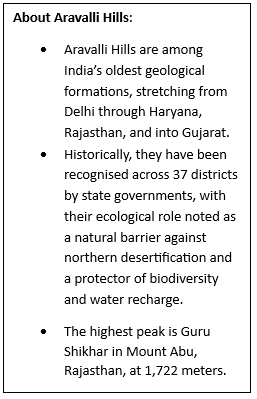
- “Aravali Hill” will be defined as any landform in the designated Aravali districts with an elevation of 100 metres or more above its local relief.
- An “Aravali Range” will be a collection of two or more such hills within 500 metres of each other.
• December 2025: The Union Ministry of Environment, Forest and Climate Change (MoEF&CC) has issued directives to –
- States for a complete ban on granting any new mining leases in the Aravalli Range.
- Indian Council of Forestry Research and Education (ICFRE) to identify additional areas or zones within the entire Aravalli Range where mining should be prohibited, beyond those currently restricted by the Centre, based on ecological, geological, and landscape-level considerations and also to prepare a comprehensive, science-based Management Plan for Sustainable Mining (MPSM) for the entire Aravalli region.
Need for Revised definition of the Aravalli hills
- Widespread Exclusion: A Down To Earth analysis of the definition revealed that nearly 50 per cent of the Aravalli hills would be exposed if the accepted definition is applied, with most of the impacted area in Rajasthan.
- Mushrooming of Mining activities: 100 metre rule opens a backdoor entry for mining of critical strategic and atomic minerals.
- Environmental Fallout: Since the Aravallis act as a barrier against desert dust migration towards Delhi NCR and neighbouring states, limiting protected areas may worsen air quality and dust storm problems.
- Neglect Significance of Low Hills: Losing protection for the smaller hills breaks the ecological continuity, risking increased air pollution, groundwater depletion, habitat loss, and human-wildlife conflicts.
Initiatives taken for the Protection of Aravallis
- Aravalli Green Wall Project: Launched in June 2025 by the Union Environment Ministry, this initiative aims to create a 5km wide green buffer around the Aravalli range in Delhi, Haryana, Rajasthan, and Gujarat.
- Matri Van Initiative: It aims to develop a large urban forest in the Aravalli region as part of the ‘Ek Ped Maa Ke Naam’ campaign, promoting mass afforestation and community participation
- MC Mehta vs. Union of India: In this landmark judgement, the Supreme Court imposed stringent restrictions and bans on illegal and unregulated mining in ecologically sensitive parts of the Aravalli range.
- NGT Interventions: The National Green Tribunal has issued multiple orders halting illegal construction, mining, and stone-crushing activities in the Aravallis and directed states to prepare conservation and restoration plans.