

SYLLABUS
GS-2: Indian Constitution—historical underpinnings, evolution, features, amendments, significant provisions and basic structure.
Context: Recently, the Ministry of Panchayati Raj has celebrated a two-day PESA Mahotsav: “Utsav Lok Sanskriti Ka” in Visakhapatnam, Andhra Pradesh.
More on the News
- The Mahotsav marks the anniversary of the Panchayats Extension to Scheduled Areas (PESA) Act, 1996.
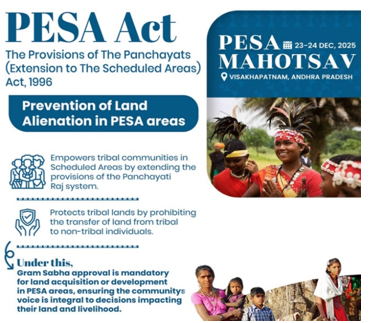
- The Mahotsav is envisioned as a landmark initiative that will showcase traditional sports like Chakki Khel, Uppanna Barelu, Cholo and Puli Meka, Mallakhamba, Pithool, Gedi Doud and Sikor; cultural heritage and tribal cuisine.
- Its objective is to empower tribal communities by providing a nationally recognised platform to celebrate, preserve and promote their rich traditions.
About PESA Act, 1996
- The Provisions of the Panchayats (Extension to the Scheduled Areas) Act, 1996 (PESA), was enacted on 24th December 1996, to extend the framework of Part IX of the Constitution (73rd Amendment Act, 1992) to the Fifth Schedule Areas, which are predominantly inhabited by tribal populations.
- The Ministry of Panchayati Raj celebrates December 24, as PESA Day.
- Under Article 243M, the 5th and 6th Schedule areas along with some other areas/states are exempted from the provisions of Part IX (Panchayats) of the Constitution. However, the Parliament by law can extend the provisions of Part IX to the Scheduled areas (5th Schedule) and the tribal areas (6th Schedule).
- Under this, the Parliament on the recommendations of the Bhuria Committee enacted the Panchayats (Extension to the Scheduled Areas) Act (PESA), 1996 to extend Part IX of the Constitution with certain modifications and exemptions to the Scheduled areas under 5th Schedule of 10 States.
- At present, 10 states have Fifth Scheduled Areas, These are: Andhra Pradesh, Chhattisgarh, Gujarat, Himachal Pradesh, Jharkhand, Madhya Pradesh, Maharashtra, Odisha and Rajasthan, Telangana.
Source:
Pib
Mha
Egramswaraj
Instagram