

SYLLABUS
GS-2: Government Policies and Interventions for Development in various sectors and Issues arising out of their Design and Implementation.
Issues Relating to Development and Management of Social Sector/Services relating to Health, Education, Human Resources.
Context: The Ministry of Home Affairs (MHA) has revised ‘Support to Poor Prisoners’ scheme guidelines citing a “sub-optimal” response from several States and Union Territories in its implementation directly impeding the realization of its core objectives.
More on the News
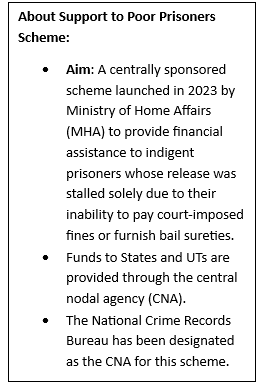
- The Ministry issued revised guidelines aimed at strengthening institutional mechanisms and ensuring swift and effective execution.
- Urging the States and Union Territories to implement the scheme in letter and spirit, the MHA said it had the potential not only to alleviate the hardships faced by poor prisoners but also help reduce overcrowding in prisons.
Key features of revised framework
- Fund Allocated: Centre allocates ₹20 crore to bail out poor prisoners
- Scrutinising Authority: District-level Empowered Committee will be tasked with scrutinising and approving eligible cases.
- It would include a nominee of the District Collector and the judge in-charge of the prison concerned, nominated by the District Judge.
- Procedure: If a convicted prisoner is unable to secure release due to non-payment of a fine –
- The Jail Superintendent must inform the Secretary of the District Legal Services Authority (DLSA) within a week.
- After verifying the prisoner’s financial status, the DLSA Secretary will recommend the case to the Empowered Committee, which may sanction a financial assistance of up to ₹25,000 to be deposited with the court to facilitate the prisoner’s release.
- If the bail amount is higher than Rs 50,000, the Empowered Committee may exercise discretion to pay a higher amount not exceeding Rs 1 lakh.
- Similar provisions apply to eligible undertrial prisoners.
- State-level Oversight Committee: In cases where the surety amount exceeds Rs 1 lakh or where the Empowered Committee does not exercise its discretion to sanction any amount between Rs 50,000 and Rs 1 lakh, the proposal shall be referred to the state-level Oversight Committee for its consideration and approval.
- Exemptions:
- excludes persons accused of offences under the Prevention of Corruption Act, Prevention of Money Laundering Act, the Narcotic Drugs and Psychotropic Substances Act, and the Unlawful Activities (Prevention) Act, and any other laws that may be notified later.
- denied benefit to those accused of heinous crimes, including acts of terrorism, offences affecting national security, dowry deaths, rape, human trafficking, and offences under the Protection of Children from Sexual Offences (POCSO) Act.
Significance:
- Ensures access to justice: The scheme strengthens fairness and efficiency in the justice delivery system by ensuring that economic hardship does not result in unjust detention.
- Reduces overcrowding in prisons: Helps undertrial prisoners secure bail or early release, easing pressure on overcrowded jails.
- Upholds Constitutional Morality: Promotes speedy trials, Upholds Article 21 (right to life and personal liberty) and reducing unnecessary delays.