
SYLLABUS
GS-3: Conservation, environmental pollution and degradation, environmental impact assessment.
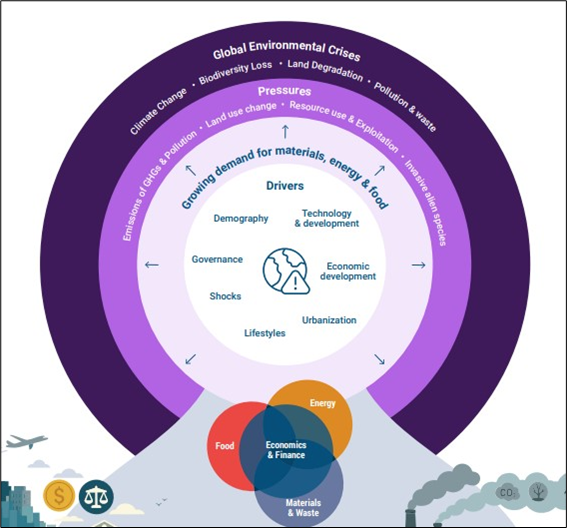
Context: The Global Environment Outlook-7 (GEO-7), released by the UN Environment Programme (UNEP), highlights how human-driven biodiversity loss and land degradation are increasingly disrupting the climate system, creating feedback loops that accelerate ecological damage.
Key Findings of the GEO-7
- Climate Change Trajectory: Global GHG emissions have risen at an average rate of 1.5% annually since 1990.
- Global mean temperatures reached 1.55°C above pre-industrial levels in 2024, intensifying extreme heat, droughts, wildfires, and floods.
- The report warns that current development pathways are incompatible with climate stability.
- Biodiversity Loss and land degradation: Nearly one million of the world’s eight million species face extinction risk.
- 20–40% of global land area is already degraded, undermining ecosystem services and affecting the livelihoods of over 3 billion people.
- The Amazon rainforest shows signs of decline due to deforestation, rising temperatures and moisture stress, with 10–47% of forests exposedto combined risks of warming, drought and fire.
- Biodiversity loss weakens carbon sinks, disrupts nutrient and water cycles, and amplifies climate impacts.
- Land, Forests and Carbon Cycle Disruption: Extreme global heat in 2023 caused a gross carbon loss of about 1.73 gigatonnesfrom terrestrial ecosystems.
- In South-East Asia, land ecosystems’ net carbon sink approaches zero during parts of the year.
- Changes in land cover alter surface reflectivity (albedo); in some high-latitude regions, reducing deforestation can paradoxically increase warming.
- Soils and Cryosphere:
- Soil carbon stocks exceed three times the combined carbon of the atmosphere and biosphere, with potential to sequester ~2,500 gigatonnes of CO₂.
- Soil emissions contribute 6.8–7.9 gigatonnes of CO₂-equivalent annually, including methane from peatlands and rice cultivation and nitrous oxide from soils.
- Pollution and Human Well-Being: Environmental pollution remains the largest global risk factor for disease and premature death.
- 99% of the global population is exposed to some form of air pollution.
- Air-pollution-related health damages were estimated at USD 8.1 trillion in 2019, equivalent to 6.1% of global GDP, disproportionately affecting low- and middle-income countries.
- Climate–Wildfire–Pollution Feedback Loop: Climate change is increasing the frequency, intensity and duration of wildfires.
- Wildfires raise GHG emissions, destroy forests and increase PM2.5 pollution.
- The probability of global wildfire occurrence is projected to rise from 1.31 today to 1.57 by 2100 without stronger action.
- Economic Costs of Environmental Degradation: Climate-related extreme weather events caused average annual economic losses of USD 143 billion over the past two decades.
- GEO-7 stresses that the cost of inaction far exceeds the cost of transformation.
- Economic Case for Transformational Change: While environmental transitions require upfront investment, net global macroeconomic benefits are projected to emerge by 2050.
- By 2070, benefits could reach around US$20 trillion annually, driven by avoided climate damage, health gains, and ecosystem restoration.
- Inclusive Knowledge and Governance: For the first time, Indigenous Peoples and holders of traditional knowledgecontributed formally to GEO through structured dialogues.
- This strengthens context-specific solutions and enhances environmental governance legitimacy.
United Nations and Environment Programme (UNEP)
- UNEP is the leading global environmental authority, established in 1972 after the Stockholm Conference.
- It unites 193 Member States to find solutions to climate change, nature and biodiversity loss, and pollution and waste, collectively known as the triple planetary crisis.
- Headquarters: Nairobi, Kenya.
About Global Environment Outlook
- The Global Environment Outlook (GEO) is UNEP’s flagship environmental assessment report series since 1995.
- It evaluates the state of the global environment, the effectiveness of policies, and future environmental trajectories at global, regional, national and local levels.
- GEO-7 was prepared by 287 experts from 82 countries, with inputs from 800+ reviewers.
- The process was mandated by a 2022 UN Member States resolution and reviewed extensively during 2024–2025