
SYLLABUS
GS-3: Infrastructure: Energy, Ports, Roads, Airports, Railways etc.
Context: Recently, the Ministry of New and Renewable Energy (MNRE) has released financial support under the PM Pradhan Mantri Kisan Urja Suraksha Evam Utthaan Mahabhiyan (KUSUM) scheme.
More on the News
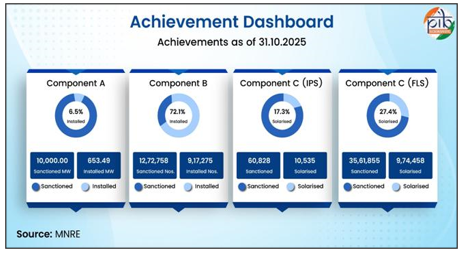
- The Centre has released ₹7,106 crore to states under the scheme till 30 November 2025, based on project demand and progress reports submitted by State Implementing Agencies (SIAs).
- As of 30 November 2025, a total of 10,203 MW has been installed under all components of the PM KUSUM Scheme.
- With over 20 lakh beneficiaries nationwide, Maharashtra leads with more than 11 lakh, followed by Rajasthan and Gujarat with over two lakh each.
- Funds under the PM KUSUM Scheme are released based on the demand received, progress reported by the SIAs, and as per provisions of the scheme guidelines.
About PM-KUSUM
- The PM KUSUM scheme launched in 2019 to add Solar capacity of 34,800 MW by March 2026 with the total Central Financial support of ₹ 34,422 crore, including service charges to the implementing agencies.
• The Scheme has the following three components:
- Component-A: Setting up of 10,000 MW of Decentralised Ground/ Stilt Mounted Grid-Connected Solar or other Renewable Energy-based Power Plants.
- Component-B: Installation of 14 Lakh Stand-alone Solar Agriculture Pumps.
- Component-C: Solarisation of 35 Lakh Grid Connected Agriculture Pumps, including Feeder Level Solarisation.
• Individual farmers have grid connected agriculture pump supporting the solarisation of pumps.
• The scheme, originally targeted for completion by 2022, now has a revised deadline of March 2026. Around 70% of standalone solar pumps have been installed, showing steady progress.
Key Objective of the Scheme
• De-dieselisation of the farm sector, providing water and energy security to farmers, increasing the income of farmers and curbing environmental pollution.
• To avoid disruption of the groundwater table, particularly in districts with depleted groundwater levels, installation of new solar pumps is not allowed under the Scheme in dark zones/areas notified by the Central Ground Water Board (CGWB).
- The Central Groundwater Board (CGWB) monitors and regulates groundwater development and extraction.
- In these dark zones/areas, only existing diesel pumps can be replaced with solar pumps under Component B of the Scheme.
- In these dark zones/areas, existing electric pumps can be solarised under Component-C of the Scheme.
- Such replacement or solarisation is permitted only if micro-irrigation techniques are used to save water.