

SYLLABUS
GS-2: Issues Relating to Development and Management of Social Sector/Services relating to Health, Education, Human Resources.
Functions and Responsibilities of the Union and the States, Issues and Challenges Pertaining to the Federal Structure.
Context: Recently, the Minister of Education introduced the Viksit Bharat Shiksha Adhishthan Bill, 2025, in the Lok Sabha to replace multiple higher education regulators with a single unified apex body.
More on the News
- The aims and purposes of this Act is to provide an effective, enabling and responsive system of regulation to encourage integrity, excellence and public-spiritedness in higher education.
- The idea of a unified regulator dates back several years, with an earlier draft of the Higher Education Commission of India (HECI) Bill first circulated in 2018.
Features of Viksit Bharat Shiksha Adhishthan Bill
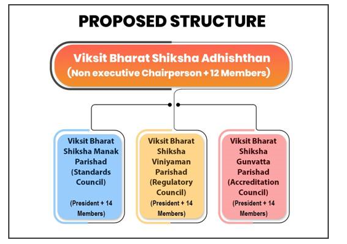
- Once the Bill is implemented, the laws governing the University Grants Commission (UGC) Act, 1956, the All India Council for Technical Education (AICTE) Act, 1987, and the National Council for Teacher Education (NCTE) Act, 1993 will be repealed and the existing bodies dissolved. Their rules and standards will continue to apply until replaced by new regulations issued by the commission.
- Exclusion: Medical, legal, pharmaceutical, dental, and veterinary programmes and institutions will remain outside the regulatory purview.
- Viksit Bharat Shiksha Adhishthan (the commission) shall consist of a Chairperson and other Members, not exceeding twelve in number, with three main wings:
- Regulatory Council (Viksit Bharat Shiksha Viniyaman Parishad)
- It will oversee compliance and transparency.
- It will act against financial or administrative irregularities, address student grievances, and prevent the commercialisation of education.
- It will prescribe conditions for foreign universities operating in India.
- The Regulatory Council will maintain a comprehensive public digital portal, where HEIs will be required to disclose information relating to financial probity, governance practices, finances, audits, procedures, infrastructure, faculty and staff, academic programmes, and educational outcomes.
- Accreditation Council (Viksit Bharat Shiksha Gunvatta Parishad)
- Assess and rate colleges and universities through a common quality framework.
- It will use online and technology-driven tools, approve and deregister accreditation agencies, monitor their performance, make accreditation outcomes public and recommend penalties for violations.
- It works towards ensuring that all higher education institutions are accredited.
- Standards Council (Viksit Bharat Shiksha Manak Parishad)
- Defines academic quality benchmarks.
- Set learning outcomes, frame guidelines to integrate vocational education with higher education, and determine levels and nomenclature for certificates and diplomas.
- It will guide curriculum design and pedagogy, promote Indian knowledge systems and languages, and recommend minimum qualifications for faculty and staff.
- Composition of Commission: Of the twelve Members referred,there shall be—
- President of the Regulatory Council—ex officio Member
- President of the Accreditation Council—ex officio Member
- President of the Standards Council—ex officio Member
- Secretary to the Government of India in the Ministry of Education, Department of Higher Education—ex officio Member
- two eminent and distinguished academicians not below the rank of Professor from the State Higher Educational Institutions—Members
- five eminent experts—Members
- Member Secretary.
- All appointments will be made by the central government.
- Penalties: The Bill empowers the Regulatory Council to impose graded penalties.
- A first violation will attract a notice seeking corrective action. Failure to comply can result in a minimum fine of ₹10 lakh.
- For a second violation, fines can go up to ₹30 lakh, along with measures such as removal of responsible officials, curtailment of autonomy or stoppage of grants.
- Repeated violations can attract fines of ₹75 lakh or more, and may lead to suspension of degree-awarding powers, cancellation of affiliation or closure of the institution.
- Setting up a college or university without government approval can attract a fine of at least ₹2 crore and immediate closure.
- Transition period: Clause 54 of the Bill states that until the commission and its councils are fully operational, the central government will appoint interim leadership. These temporary arrangements will last up to two years or until the new bodies are constituted, whichever is earlier.
- Overriding powers: If the central government believes that the commission or any council is not functioning properly or is repeatedly ignoring directions, it can, with the President’s approval, suspend and replace the body for up to six months.
- Financial autonomy: Funding and financial autonomy will remain with the administrative ministry rather than the regulator itself.
Significance of the Bill
- Renewed effort to implement the NEP 2020 vision: This move follows recommendations in the National Education Policy (NEP) 2020 for a single regulatory authority to streamline governance and oversight in India’s higher education sector.
- “Light but Tight” regulatory framework: It provides universities more autonomy to run their own affairs, while maintaining quality through a clear and transparent accreditation system.
- Integration of Bharatiya knowledge systems: It focuses on developing a roadmap to integrate “Bharatiya knowledge, languages, and arts” in higher education, aligning with the broader vision of an Aatmanirbhar Bharat.
- Teeth to penalties: The Bill empowers the body to impose penalties for violations – ranging from Rs 10 lakh to Rs 2 crore.