
SYLLABUS
GS-3: Conservation, environmental pollution and degradation, environmental impact assessment.
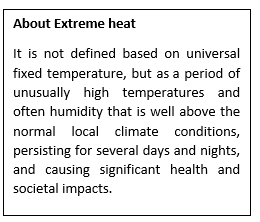
Context: Recently, a new study published in Global Change Biology warns that climate change-induced extreme heat events combined with land use change could threaten the survival of nearly 8,000 vertebrate species by the end of the 21st century.
More on the News
- The study was conducted by an international group of researchers analysing nearly 30,000 vertebrate species across the world.
- Vertebrate Species refers to any distinct type of animal that possesses a backbone or vertebral column (made of bone or cartilage) and an internal skeleton.
- The analysis evaluates future exposure to extreme heat events and land use change from 2015 to 2100.
- The study emphasises the synergistic impact of climate change and land use change, showing that their combined effect is more damaging than either factor acting alone.
Key Highlights of the Report
Scale of the Extinction Risk:
- Up to 7,895 vertebrate species may potentially face global extinction by the end of the century due to unsuitable climatic and land use changes.
- Under the worst-case scenario, unsuitable conditions are projected to spread across about 52% of species’ current habitat range.
- Such widespread habitat unsuitability severely restricts species’ ability to survive, migrate, or adapt.
Climate Scenarios Analysed:
- The study examines four combined climate–development pathways:
- SSP1–RCP2.6: Sustainable development with low warming (optimistic scenario).
- SSP2–RCP4.5: Middle-of-the-road development trajectory.
- SSP3–RCP7.0: Regional conflict scenario characterised by high land-use pressure and weak environmental governance.
- SSP5–RCP8.5: Fossil-fuel-driven, high-emission “business-as-usual” scenario.
- SSPs (Shared Socioeconomic Pathways) describe future societal development patterns, while RCPs (Representative Concentration Pathways) indicate levels of greenhouse gas–driven radiative forcing.
Impact of Extreme Heat and Land Use Change:
- Climate change and land use change together are projected to render large portions of existing habitat unsuitable by 2100.
- Under high emission scenarios, nearly 52.4% of currently suitable habitat areas may become inaccessible compared to 2015 levels.
- Even under the low warming SSP1–RCP2.6 pathway, about 12.4% of species are still expected to be exposed to extreme heat events, highlighting unavoidable risks.
- Land use change significantly amplifies heat stress by fragmenting habitats and limiting species’ adaptive and migratory capacity.
Species Most at Risk:
- Amphibians and reptiles are consistently projected to face higher exposure to unsuitable conditions than birds and mammals under all future scenarios.
- Even in the most optimistic scenarios:
- Amphibians may lose over 23% of their 2015 habitat range.
- Reptiles may lose around 13%.
- Higher vulnerability is strongly associated with smaller geographic ranges, ectothermic physiology, moisture dependence, and higher IUCN threat categories.
Regional Hotspots of Impact:
- The strongest combined impacts of extreme heat and land use change are projected in:
- The Sahel region (Sudan, Chad, Mali)
- The Middle East (Afghanistan, Iraq, Saudi Arabia)
- Brazil
- In the worst-case scenario, extensive habitat unsuitability is expected across Brazil, Bolivia, Paraguay, North Africa, India and Western Australia due to compounded heat stress and land transformation.
Significance of the Study
- The study demonstrates that climate change and land use change together pose a far greater threat to biodiversity than either factor in isolation.
- It underscores the urgency of integrated climate mitigation, sustainable land-use planning, and biodiversity conservation policies.
- The findings are highly relevant for achieving the Kunming–Montreal Global Biodiversity Framework targets and advancing SDGs 13 (Climate Action) and 15 (Life on Land).
- They provide critical evidence for guiding global conservation prioritisation, climate adaptation strategies, and long-term sustainable development planning.