

SYLLABUS
GS-3: Science and Technology- Developments and their Applications and Effects in Everyday Life.
Achievements of Indians in Science & Technology; Indigenization of Technology and Developing New Technology.
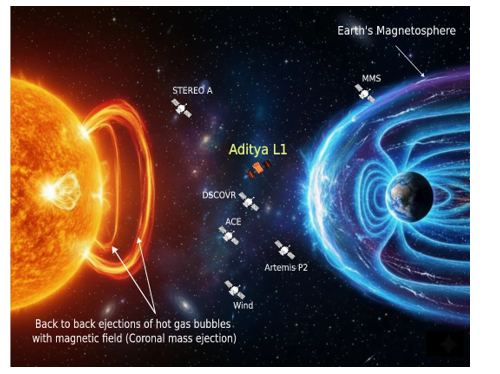
Context: In a major breakthrough, India’s first solar observatory, Aditya-L1, along with six U.S. satellites, has revealed why the May 2024 solar storm, also known as Gannon’s storm, behaved so unusually.
Key Findings of the Study
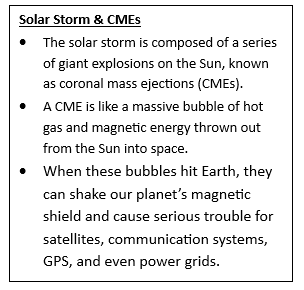
- According to the Indian Space Research Organisation (ISRO), during the May 2024 solar storm, scientists discovered something unusual: the Sun’s magnetic fields, which are like twisted ropes inside a solar storm, were breaking and rejoining within the storm.
- Usually, a CME (coronal mass ejection) carries a twisted “magnetic rope” that interacts with Earth’s magnetic shield as it approaches Earth.
- But this time, two CMEs collided in space and squeezed each other so firmly that the magnetic field lines inside one of them snapped and rejoined in new ways, a process called magnetic reconnection.
- Satellites also detected particles suddenly speeding up, indicating an increase in their energy, confirming the magnetic reconnection event.
- The study also found that the area where the CME’s magnetic field was tearing and reconnecting was enormous – about 1.3 million kilometres across, i.e, nearly 100 times the size of Earth. It was the first time such a giant magnetic breakup and rejoining had ever been seen inside a CME.
Significance of the Findings
- Multiple Observation: For the first time, researchers could study the same extreme solar storm from multiple vantage points in space.
- Solar storms Insight: The discovery is expected to enhance the understanding of how solar storms evolve and intensify while travelling from the Sun toward Earth, improving models of space-weather dynamics.
- India’s entry to elite club: Aditya-L1’s contributions demonstrate India’s growing leadership in global space science and heliophysics research.
About Aditya-L1
- Aditya L1 is the first space-based Indian mission to study the Sun. The spacecraft is placed in a halo orbit around the Lagrange point 1 (L1) of the Sun-Earth system, which is about 1.5 million km from the Earth.
- Lagrange points are specific locations in space where the combined gravitational forces of two large orbiting bodies (such as the Sun and Earth) and the centrifugal force balance each other out, thus providing gravitational stability and minimizing the need for frequent orbital maintenance efforts.
- There are five Lagrange points (L1 to L5) for any two-body system.
- Aditya L1 has 7 distinct payloads developed, all developed indigenously.
- Using the special vantage point L1, four payloads directly view the Sun, and the remaining three payloads carry out in-situ studies of particles and fields at the Lagrange point L1, thus providing important scientific studies of the propagatory effect of solar dynamics in the interplanetary medium.