
SYLLABUS
GS-2: Structure, Organization and Functioning of the Executive and the Judiciary—Ministries and Departments of the Government; Pressure Groups and Formal/Informal Associations and their Role in the Polity.
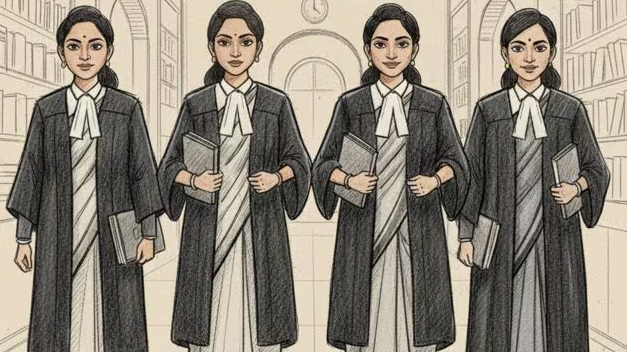
Context: Recently, the Supreme Court mandated 30% seats to be reserved for women in State Bar Councils, with 20% seats to be filled through direct election and 10% through co-option for this year’s elections.
More on the News
- The Supreme Court clarified that the reservation would extend not only to elected positions but also to the posts of office-bearers in every State Bar Council.
- The Court directed State Bar Councils to co-opt women members whenever the number of women candidates is insufficient to satisfy the mandated 30% reservation.
- Earlier, in May 2024, during the Supreme Court Bar Association elections, the court mandated 33% reservation for women in Supreme Court Bar Association (SCBA) posts.
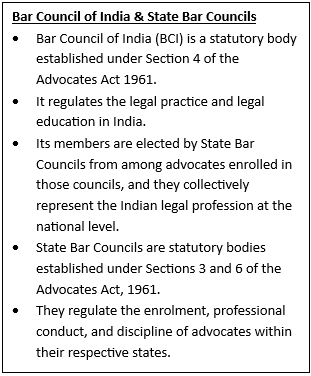
- Now, the court has extended gender-inclusion measures from voluntary associations to statutory councils, which control enrollment, disciplinary powers, and policy decisions nationwide.
Significance of the Judgement
- Promotes Substantive Gender Representation: The judgement ensures that women, who have been historically marginalised in bar council leadership, gain meaningful and enforceable representation in both elected posts and office-bearer positions, thereby addressing chronic underrepresentation in a male-dominated profession.
- Promotes Diverse Decision-Making: Brings women’s perspectives into key regulatory functions nationwide, aligning with constitutional equality under Articles 14-15 and boosting professional reforms.
- For instance, Data before the Supreme Court showed that across 18 State Bar Councils, barely 2% i.e., only 9 of 441 elected members are women, and 11 Bar Councils have no women members at all.
- Facilitates Retention and Career Progression: With more women in leadership roles, institutional culture becomes more supportive, improving retention and reducing early drop-out rates.
- For instance, the recent SCBA survey found that women drop out after 5–6 years due to a lack of support.
Implementation Hurdles
- Tokenism: Senior women advocates warn that without clear compliance timelines, transparent co-option processes, the reform may remain on paper, becoming a tool for tokenism.
- Compliance Issue: There is a real risk of delay or dilution, as some State Bar Councils may try to postpone elections or create procedural hurdles.
- Development of proxy candidates: There is a risk that entrenched male networks may field female relatives as proxy candidates, which could undermine genuine representation and reduce elected women to symbolic placeholders.
Way Ahead
- Strengthen Compliance and Monitoring Mechanisms: The Supreme Court or Bar Council of India can mandate regular compliance reports, fixed election timelines, and oversight committees to prevent delays, dilution, or misuse of the reservation policy.
- Build a Genuine Leadership Pipeline for Women: Introduce capacity-building programs, mentorship networks, and financial/administrative support to ensure that women candidates are empowered, not reduced to proxies.
- Ensure Transparent and Standardised Election Processes: Implement uniform election rules across states, enforce transparent co-option procedures, and use digital platforms for nominations and disclosures to curb manipulation and enforce accountability.