
SYLLABUS
GS-2: Important International institutions, agencies and fora – their structure, mandate.
Context: Recently, Interpol issued a Blue Corner Notice against Luthra Brothers, owners of the Goa nightclub where a massive fire claimed 25 lives.
More on the News
- A Blue Corner Notice is a tool used by Interpol to help law enforcement in member countries collect information on a person’s identity, location, or activities related to an investigation.
- Additionally, the government also used Section 10A of the Passports Act to suspend the brothers’ passports and stop them from travelling anywhere.
About the International Criminal Police Organisation (Interpol)
- INTERPOL is an intergovernmental organisation founded in 1923 as the International Criminal Police Commission (ICPC) and adopted its current official name and constitution in 1956.
- It comprises 196 member countries. Its headquarters is in Lyon, France, and a liaison
office is in New York, United States. - It facilitates international police cooperation by enabling information exchange on crimes and criminals through a centrally coordinated global network.
- It provides member countries with access to global criminal databases and coordinates communication through National Central Bureaus (NCBs).
- It offers technical, operational, and analytical support to assist police forces in tackling transnational crimes.
- Each member country hosts a National Central Bureau, serving as the primary liaison between local law enforcement and Interpol.
- India joined the Interpol in 1949. In India, the Central Bureau of Investigation (CBI) acts as the designated nodal agency.
About Interpol Notices
- Interpol Notices are international requests for cooperation or alerts allowing police in member countries to share critical crime-related information.
- Notices are issued by the General Secretariat at the request of a member country’s Interpol National Central Bureau and are made available for all our member countries to consult in our Notices database.
- Types of Notice:
- Red Notice: To seek the location and arrest of persons wanted for prosecution or to serve a sentence.
- Yellow Notice: To help locate missing persons, often minors, or to help identify persons who are unable to identify themselves.
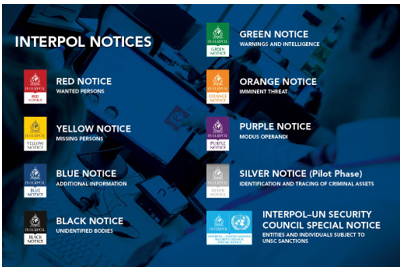
- Blue Notice: To collect additional information about a person’s identity, location or activities in relation to a criminal investigation.
- Black Notice: To seek information on unidentified bodies.
- Green Notice: To provide a warning about a person’s criminal activities, where the person is considered to be a possible threat to public safety.
- Orange Notice: To warn of an event, a person, an object or a process representing a serious and imminent threat to public safety.
- Purple Notice: To seek or provide information on modus operandi, objects, devices and concealment methods used by criminals.
- Silver Notice (pilot phase): To identify, trace, and recover criminal assets.
Source:
Newindianexpress
Indianexpress
Economictimes
Interpol
Interpol