
SYLLABUS
GS-3: Conservation, environmental pollution and degradation, environmental impact assessment.
Context: Recently, the Department of Science and Technology (DST) released India’s first Research and Development Roadmap for Carbon Capture, Utilisation and Storage (CCUS).
More on the News
- The roadmap was launched by the Principal Scientific Adviser (PSA) to the Government of India and provides direction for CCUS technology advancement and deployment.
- The roadmap aims to strengthen collaboration, support investments and accelerate the deployment of CCUS technologies to reduce India’s carbon footprint and reinforce its global climate responsibility.
- The Department of Science and Technology plans to implement the roadmap through the ₹1 lakh crore Research, Development and Innovation (RDI) Scheme to promote private-sector-led industrial decarbonisation.
About Carbon Capture, Utilisation and Storage (CCUS)
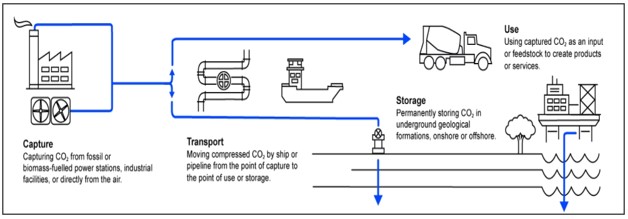
- CCUS involves the capture of CO2, generally from large point sources like power generation or industrial facilities that use either fossil fuels or biomass as fuel.
- If not being used on-site, the captured CO2 is compressed and transported by pipeline, ship, rail or truck to be used in a range of applications, or injected into deep geological formations such as depleted oil and gas reservoirs or saline aquifers.
Significance of CCUS for India
- CCUS is expected to play a transformative role in enabling industrial decarbonisation in the country, aligning with the nation’s overarching goal of achieving ‘Net Zero’ by 2070.
- By promoting indigenous Research and Development (R&D), CCUS reduces dependence on imported technologies.
- The roadmap balances advancing current technologies toward commercial readiness with supporting breakthrough science to drive next-generation solutions.
- The integration of CCUS technologies may contribute to the development of a circular carbon economy, wherein captured carbon dioxide is repurposed into value-added products such as synthetic fuels, fertilizers, construction materials, and industrial gases.
- When combined with biomass (BECCS) or direct air capture (DAC), it can actively remove CO2 from the atmosphere, creating negative emissions.
- It will support the reduction of the nation’s carbon footprint and reinforce India’s role as a responsible global partner, marking an important step toward a sustainable future aligned with the vision of Viksit Bharat@2047.