
SYLLABUS
GS-1: Indian Culture – Salient aspects of Art Forms, Literature and Architecture from ancient to modern times.
Context: Recently, the Prime Minister of India visited the Somnath Temple on May 11, 2026, to mark the 75th anniversary of the reopening and consecration of the reconstructed Somnath Temple in 1951.
More on the News
• The occasion is being commemorated through the “Somnath Amrit Mahotsav” and “Somnath Swabhiman Parv”, highlighting the temple’s enduring civilisational, spiritual, and cultural significance.
• The event also coincides with the completion of 1,000 years since the first recorded attack on the temple by Mahmud of Ghazni in 1026 CE, making it a symbol of resilience, reconstruction, and cultural continuity.
Historical Background of Somnath Temple
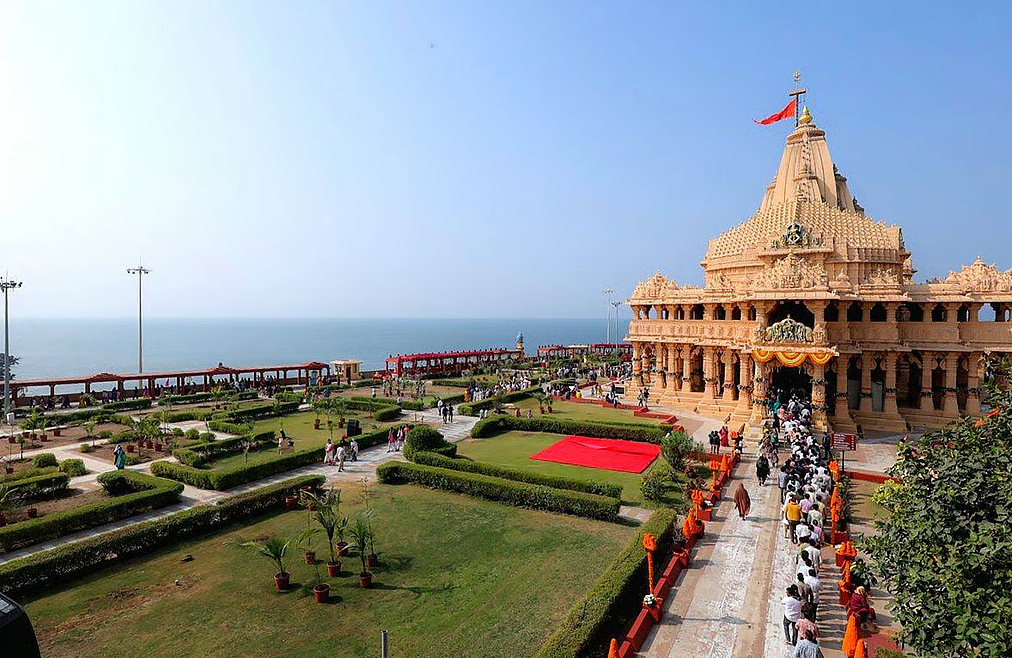
• Somnath Temple, located at Prabhas Patan in Gujarat’s Saurashtra region, is revered as the first among the twelve Jyotirlingas of Lord Shiva and has historically been one of India’s most prominent pilgrimage centres.
• Owing to its religious importance and strategic coastal location, the temple also emerged as a major centre of trade, maritime activity, and cultural exchange in western India.
• The temple faced repeated invasions and destruction across centuries, most notably by Mahmud of Ghazni in 1026 CE, followed by attacks during the Delhi Sultanate and later medieval periods.
• Despite repeated destruction, Somnath was rebuilt several times by different rulers and devotees, reflecting the continuity of India’s spiritual traditions and cultural resilience.
- The Solanki ruler Bhima I is believed to have undertaken early restoration efforts after the Ghaznavid invasion.
- King Kumarapala of the Chaulukya dynasty restored the temple during the 12th century.
- In the 18th century, Queen Ahilyabai Holkar of Indore constructed a new Shiva temple near the original site and played an important role in reviving pilgrimage activities at Somnath.
Reopening of the Temple in Independent India
• After Independence, Sardar Vallabhbhai Patel took the initiative to rebuild the Somnath Temple as a symbol of national self-confidence and cultural resurgence.
• The reconstruction effort received support from K.M. Munshi and the Somnath Trust, while the Government ensured that the rebuilding was undertaken through public contributions rather than state funding.
• The reconstructed temple was inaugurated on 11 May 1951 by India’s first President, Dr. Rajendra Prasad, who described Somnath as a symbol of India’s spiritual strength and national revival.
Architectural and Cultural Significance
• The present Somnath Temple has been built in the Maru-Gurjara (Chalukyan) style of architecture, known for intricate carvings, towering shikharas, and ornate temple design.
• The temple’s “Baan Stambh” symbolically indicates that there is no landmass between Somnath and Antarctica along a straight line in the southern direction.
• Somnath continues to serve as an important centre of Shaivite worship, pilgrimage tourism, and preservation of India’s temple traditions.