
SYLLABUS
GS-2: Bilateral, Regional and Global Groupings and Agreements involving India and/or affecting India’s interests.
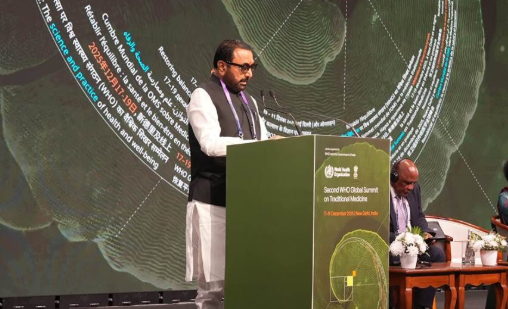
Context: The 2nd WHO Global Summit on Traditional Medicine, jointly organised by the World Health Organisation (WHO) and the Union Ministry of Ayush, was held from December 17 to 19 at Bharat Mandapam, New Delhi.
More on the News
- The summit served as a critical platform for policymakers, scientists, and practitioners from over 100 countries to deliberate on the theme ‘Restoring Balance – The Science and Practice of Health and Well-Being’.
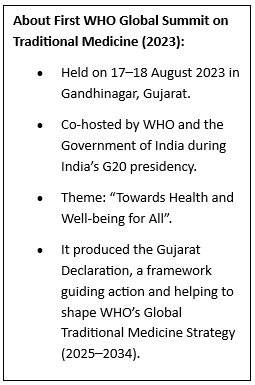
- WHO Director-General praised India’s leadership in traditional medicine, emphasizing that the newly adopted WHO Global Traditional Medicine Strategy 2025–2034 will prioritize evidence-based science and the integration of traditional systems into primary healthcare.
The Delhi Declaration on Traditional Medicine: Outcome of the Second WHO Global Summit on Traditional Medicine (2025)
- Aim: To advance a global movement to restore balance for people and the planet, grounded in the science and practice of Traditional Medicine.
- Launch of the WHO Global Traditional Medicine Library (TMGL): a massive digital repository containing over 1.5 million records to enhance evidence-based traditional medicine for health, well-being and planetary balance.
- Global harmonization of traditional knowledge: 104 annual scholarships for foreign nationals and the upcoming completion of the WHO Global Traditional Medicine Centre in Jamnagar by October 2025.
- Digital technology Integration: Expo showcased digital health technology, AI-based tools, research innovations, and modern wellness infrastructure, which together demonstrated a new collaboration between tradition and technology.
- Discussions on the ‘Ayush Grid’ and the use of artificial intelligence to validate ancient knowledge systems.
- launch of the ICD-11 Module 2, which integrates Ayurveda, Siddha, and Unani morbidity codes into international health classifications.
- India’s partnerships of healing across the world: establishment of a Centre of Excellence for BIMSTEC countries, covering South and South-East Asia, and a collaboration with Japan aimed at integrating science, traditional practices, and health.
- India’s partnership with the WHO: inauguration of the new WHO-South East Asia Regional Office complex in Delhi, which will also house the WHO India Country Office.
Significance of the summit
- It underscores India’s growing leadership and pioneering initiatives in shaping a global, science-based and people-centred Traditional Medicine agenda.
- It emphasised mainstreaming traditional medicine and the Indian Knowledge System through research, standardisation, and global collaboration.
- It demonstrated how modern technology can be leveraged to document and protect traditional medical heritage while ensuring fair benefit-sharing for local communities.