SYLLABUS
GS-2: Important International institutions, agencies and fora- their structure, mandate.
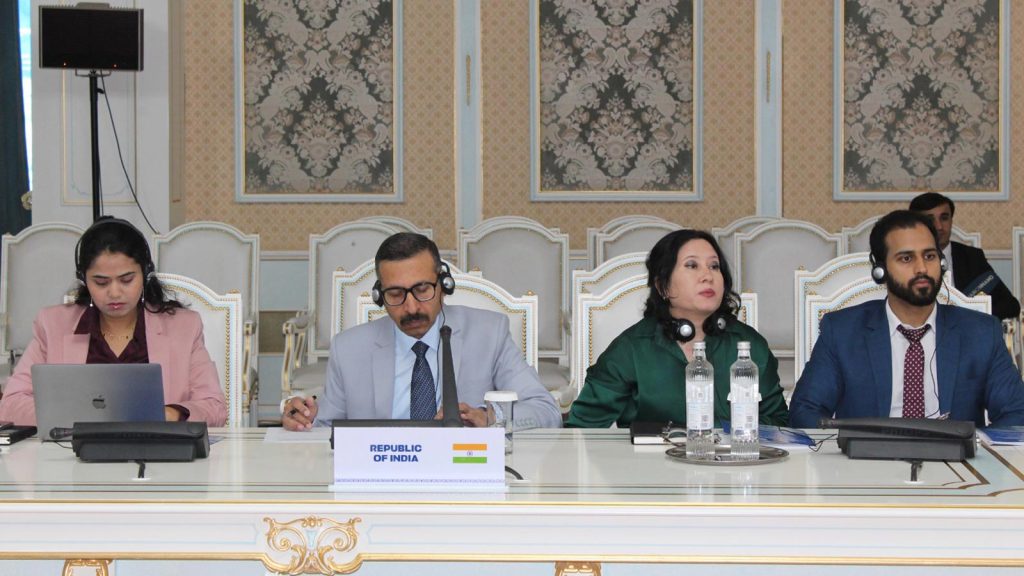
Context: Raksha Mantri Rajnath Singh represented India at the 25th SCO Council of Heads of Government meeting in Dushanbe, Tajikistan, on 20 October 2026, focusing on security, economic cooperation and regional connectivity.
Key Outcomes of the Meeting
- Collective Action Against Terrorism: India called for dismantling the entire ecosystem of terrorism, including its financing, support networks and safe havens, without double standards.
- Economic and Trade Cooperation: Member states adopted the Action Plan for the Programme of Multilateral Trade and Economic Cooperation (PMTEC) for 2026–2030 to strengthen trade, investment and economic cooperation.
- Institutional Development: The meeting welcomed the Universal Centre in Tashkent and the Anti-Drug Centre in Dushanbe as permanent SCO bodies.
- The SCO budget for 2027 was approved.
- SCO Development Bank: The proposed bank aims to finance multilateral projects.
- Kazakhstan expressed readiness to host its headquarters.
- Connectivity and Sustainable Development: India highlighted INSTC and Chabahar Port for regional connectivity.
- It also highlighted Digital Public Infrastructure, women-led development, the International Solar Alliance, CDRI, Mission LiFE and the Global Biofuel Alliance, while stressing respect for sovereignty and territorial integrity in connectivity projects.
- Asian Economic Dialogue: Rajnath Singh acknowledged the organisation of the first-ever SCO Asian Economic Dialogue.
- Joint Communiqué: Member states adopted the Joint Communiqué covering the meeting’s decisions, including the 2027 budget and the PMTEC Action Plan.
- Civilisational Cooperation: India invited member states to the first SCO Civilisational Dialogue Forum, to be hosted by India later in 2026.
- Next Meeting: The chairmanship passed to Uzbekistan, which will host the next meeting in 2027.
About the Shanghai Cooperation Organisation (SCO)
- Establishment: Established on 15 June 2001 in Shanghai, China, evolving from the Shanghai Five mechanism established in 1996.
- Headquarters: Beijing, China.
- Official Languages: Chinese and Russian.
- Secretary-General: Nurlan Yermekbayev, who assumed office on 1 January 2025 for a three-year term.
- Membership: 10 member states — China, Russia, Kazakhstan, Kyrgyzstan, Tajikistan, Uzbekistan, India, Pakistan, Iran and Belarus.
- Observers and Dialogue Partners: The SCO has 2 observer states (Afghanistan and Mongolia) and 15 dialogue partners; a unified “SCO Partner” status was approved in 2025 but is not yet fully implemented.
- Evolution of Membership: India and Pakistan became full members in 2017, Iran in 2023 and Belarus in 2024.
- Core Objectives:
- Strengthen mutual trust, good-neighbourliness and friendly relations among member states.
- Promote regional peace, security and stability.
- Combat terrorism, separatism, extremism, organised crime and other transnational threats.
- Enhance cooperation in trade, investment, energy, science and technology, culture and environmental protection.
- Guiding Principles: The Shanghai Spirit, emphasising mutual trust, mutual benefit, equality, consultation, respect for cultural diversity and pursuit of common development.
- Permanent Bodies:
- SCO Secretariat: Beijing, China.
- Executive Committee of the Regional Anti-Terrorist Structure (RATS): Tashkent, Uzbekistan.
- Organisational Structure: The Council of Heads of State (CHS) is the SCO’s highest decision-making body, responsible for determining major priorities, while the Council of Heads of Government (CHG) focuses primarily on economic cooperation and budgetary matters.