
SYLLABUS
GS-1: Important Geophysical phenomena such as earthquakes, Tsunami, Volcanic activity, cyclone, etc.
GS-3: Disaster and disaster management.
Context: India is set to have over 100 tsunami-ready villages across the Indian Ocean region, becoming the first country in the region to achieve this milestone.
More on the News
- A tsunami-ready village meets standards for tsunami awareness, preparedness, hazard mapping, evacuation planning, 24-hour warning systems, and regular mock drills, as certified by UNESCO’s Intergovernmental Oceanographic Commission (IOC).
- IOC promotes international cooperation in marine sciences, enabling its 152 Member countries to collaborate on ocean management through programmes in capacity building, ocean observations, science, tsunami warning, and ocean literacy.
- Tsunami-ready is a voluntary, community-based programme that promotes tsunami preparedness through collaboration with the public, community leaders, and local and national emergency agencies.
- As of late 2025, India currently has 24 certified tsunami-ready villages, all located in Odisha across six districts, and the state is now planning to add 72 more tsunami-ready villages.
- States and UTs like Gujarat, Kerala, Andhra Pradesh and Andaman and Nicobar islands have also identified some villages. By March or April 2026, Kerala has proposed nine coastal villages for this initiative.
- To obtain “Tsunami-Ready” certification for a village, the community must fulfil 12 standardised indicators established by UNESCO’s Intergovernmental Oceanographic Commission (IOC).
- The process is a voluntary, community-based initiative coordinated in India by the Indian National Centre for Ocean Information Services (INCOIS).
- It was established as an autonomous body in 1999 under the Ministry of Earth Sciences (MoES) and is a unit of the Earth System Science Organisation (ESSO) to operate the Indian Tsunami Early Warning Centre provides 24/7 monitoring and warning services.
About Tsunami
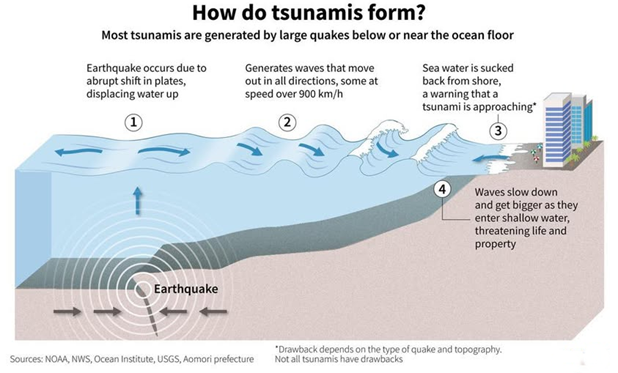
- Tsunamis are waves generated by the tremors and not an earthquake in itself. Though the actual quake activity lasts for a few seconds, its effects are devastating provided the magnitude of the quake is more than 5 on the Richter scale.
- Volcanic eruptions, submarine landslides, and coastal rock falls can also generate a tsunami, etc, impacting the ocean.
- Tsunamis originate from a vertical movement of the sea floor with the consequent displacement of the water mass.
- There are three factors of destruction from tsunamis:
- Inundation: The horizontal distance inland that a tsunami penetrates. This results in massive flooding of coastal towns, villages, and farmland, often contaminating freshwater supplies and making agricultural land unusable.
- Wave Impact on Structures: The physical force of a wall of water traveling at high speeds. These immense wave forces can demolish frame buildings, smash roads and bridges, and turn objects like boats and cars into dangerous projectiles.
- Erosion: Strong, tsunami-induced currents wear away foundations, leading to the collapse of seawalls and bridges. This process reshapes the coastal geography by carrying away large amounts of sediment and rock
Initiatives by the Government
- Faster Alerts: Scientists are integrating 32 GNSS sensors in the Andaman and Nicobar Islands and using AI/Machine Learning to reduce warning times from 10 minutes to under five minutes.
- Smart Cables: Recent initiatives include developing underwater smart cables with seafloor sensors to detect tsunamis caused by undersea landslides, which surface buoys might miss.
- Mobile Warning Systems: INCOIS launched a trial for a cell broadcast common alerting system in late 2025 to send instantaneous alerts directly to mobile phones in vulnerable areas.
- Regional Provider: India serves as a Tsunami Service Provider (TSP) for 28 Indian Ocean Rim countries, providing real-time data and advisories.
- IOWave25 Exercise: In late 2025, India coordinated the IOWave25 mock drill (September 25 – November 5) to test the readiness of its national and regional warning chains.
- Global Symposium: In November 2025, India hosted the 32nd International Tsunami Symposium, focusing on non-seismic tsunami detection and high-performance computing for inundation modelling.
- Global Recognition: The UN General Assembly has designated 5 November as World Tsunami Awareness Day.